A practical guide to IL, TL, and NR for Health, Safety, and Productivity
Noise control in industrial environments relies on accurate acoustic metrics. Three measurements are used most often across Australian workplaces: Insertion Loss (IL), Transmission Loss (TL) and Noise Reduction (NR). While each describes sound reduction in a different way, they all help guide decisions that support health, safety, and productivity on industrial sites.
This overview explains how each metric works within the context of common Australian Standards, and how they support the performance of Flexshield Group solutions.
Insertion Loss (IL)
IL shows how much noise is reduced when a specific device is placed into an existing noise path. Examples include silencers, acoustic liners, or other engineered add-ons used in HVAC systems, ducts, or pipework.
How IL works
IL is measured by recording the sound level before and after the device is installed. Because it is tested under real operating conditions, IL accounts for factors such as airflow, turbulence, and resonances. The measurement is frequency-dependent and usually reported in octave bands from 125 Hz to 8 kHz.
Calculating IL
IL = SPL without device minus SPL with device
Testing methods are guided by ISO 7235, which is also referenced within Australian acoustic practice.
Where IL is used
Commonly applied to HVAC silencers, exhaust systems, and similar devices where the focus is on the performance of the product itself rather than the whole environment.
Transmission Loss (TL)
TL measures how well a partition such as a wall, floor, barrier, or panel reduces sound passing from one space to another. It concentrates on the behaviour of the material rather than the room.
How TL works
Sound hits the surface of a barrier and some energy passes through. TL reflects the difference between the incoming and transmitted sound power. Heavier materials usually block more low-frequency energy, while stiffness and coincidence effects influence performance at other frequencies. TL is tested in laboratory transmission suites under controlled diffuse-field conditions.
Calculating TL
TL = 10 log₁₀ (incident power divided by transmitted power)
In Australia, TL is measured under AS 1191-2002, with ratings provided using AS/NZS 1276.1.
Where TL is used
Building partitions, acoustic screens, flexible barriers, and other structures where material performance is the priority.
Noise Reduction (NR)
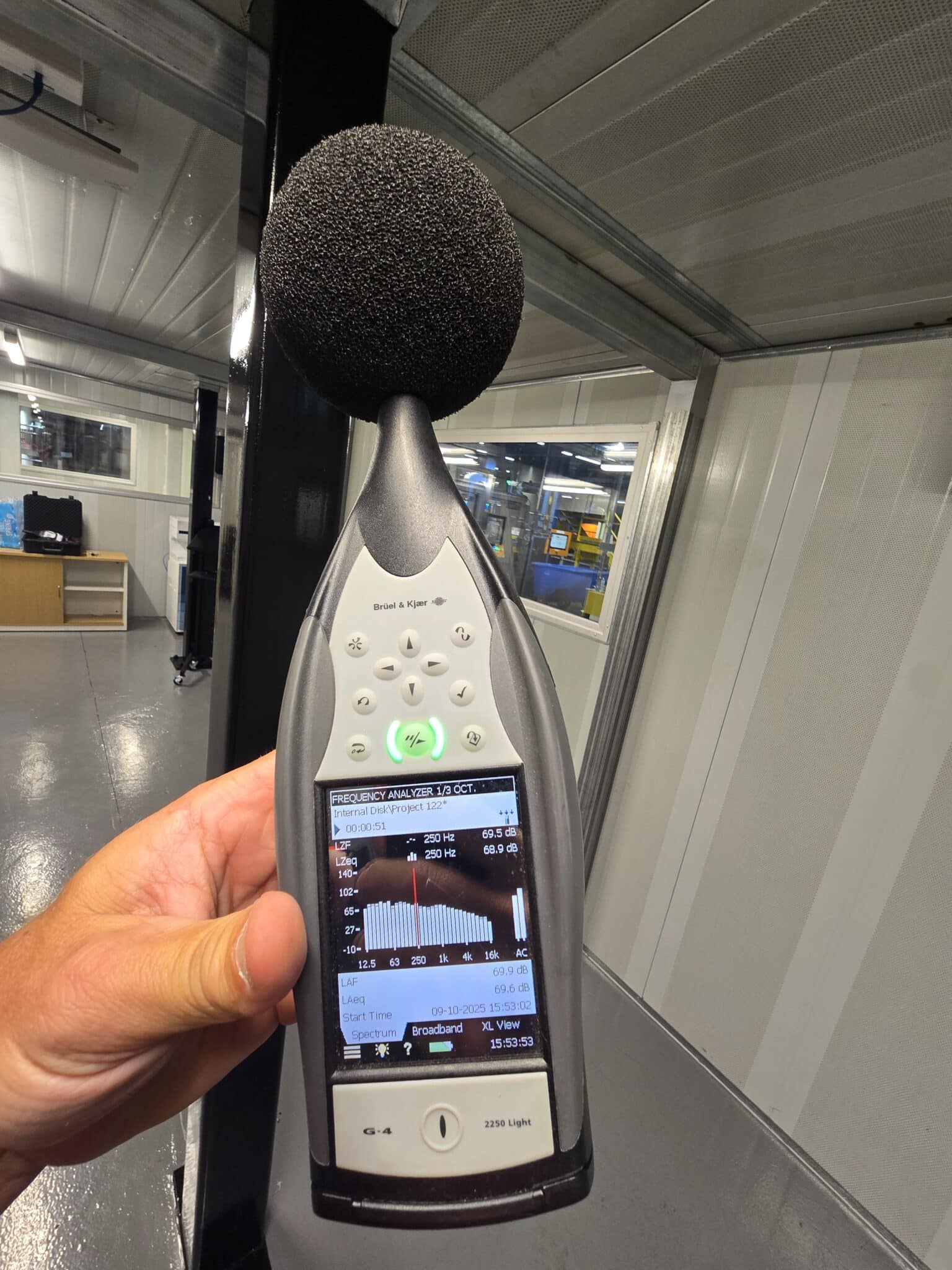
NR represents the total change in sound level between a noise source and a receiver position. It considers all contributing factors including barriers, room absorption, reflections, and the shape of the space. NR is always measured in the field.
How NR works
NR records the difference between the source SPL and the receiver SPL in a real environment. Because it captures the actual space, it often uses A-weighted levels to reflect human perception.
Calculating NR
NR = SPL at source minus SPL at receiver
Predictive models may use
NR = TL + 10 log₁₀ (S/A)
where S is barrier area and A is the absorption of the receiving space. This aligns with the AS/NZS 1276 series.
Where NR is used
Room-to-room assessments, enclosure performance, and overall system checks. NR can also assist in meeting design guidelines such as AS/NZS 2107 for recommended internal noise levels.
Adjusting for the real world: the 6 dB Rule for NR and TL
A common estimation method for partitions between reverberant spaces is:
NR ≈ TL + 6 dB
This rule provides a practical field adjustment to laboratory TL values. The +6 dB accounts for how sound behaves in occupied spaces where reflections and varying angles of incidence change the way noise is experienced. Actual site results may vary slightly depending on absorption, flanking paths, and room size.
IL does not link to this rule because IL focuses on device performance under operating conditions rather than partition behaviour.
IL, TL, and NR Summary Table
| Metric |
Focus |
Measurement Context |
Key Formula |
Typical Use |
| IL |
Device performance |
Operating conditions such as airflow |
IL = change in SPL |
Silencers, ductwork, exhaust systems |
| TL |
Material isolation |
Laboratory test suites |
TL = 10 log (incident ÷ transmitted) |
Walls, panels, acoustic barriers |
| NR |
Result within the space |
Field measurement |
NR ≈ TL + 6 dB (estimation) |
Room-to-room checks, enclosures |
Learn more about acoustic measurements for industry with Flexshield
These three metrics allow industrial facilities to choose the right materials, design the right systems, and validate real-world outcomes. IL helps assess add-on products, TL guides material selection, and NR confirms actual performance in the environment.
We’ll make sure it’s built right from the start. To speak with our noise control experts, contact Flexshield on 1300 799 969 or get in touch online.
Proudly built by Flexshield Group
Designed to perform. Built to last.