
Call 1300 799 969 | Contact Us
Home » Why NATA-accredited acoustic testing matters for industrial products
When specifying acoustic products for industrial projects, the gap between tested performance and marketing claims can have real consequences.
For engineers, acoustic consultants, and project managers, understanding what NATA-accredited test results mean and why they matter is important for making defensible specification decisions.
The National Association of Testing Authorities (NATA) is Australia’s national accreditation body for testing and calibration laboratories. A NATA-accredited laboratory has demonstrated that it operates to recognised standards, with documented procedures, qualified staff, and verified measurement equipment.
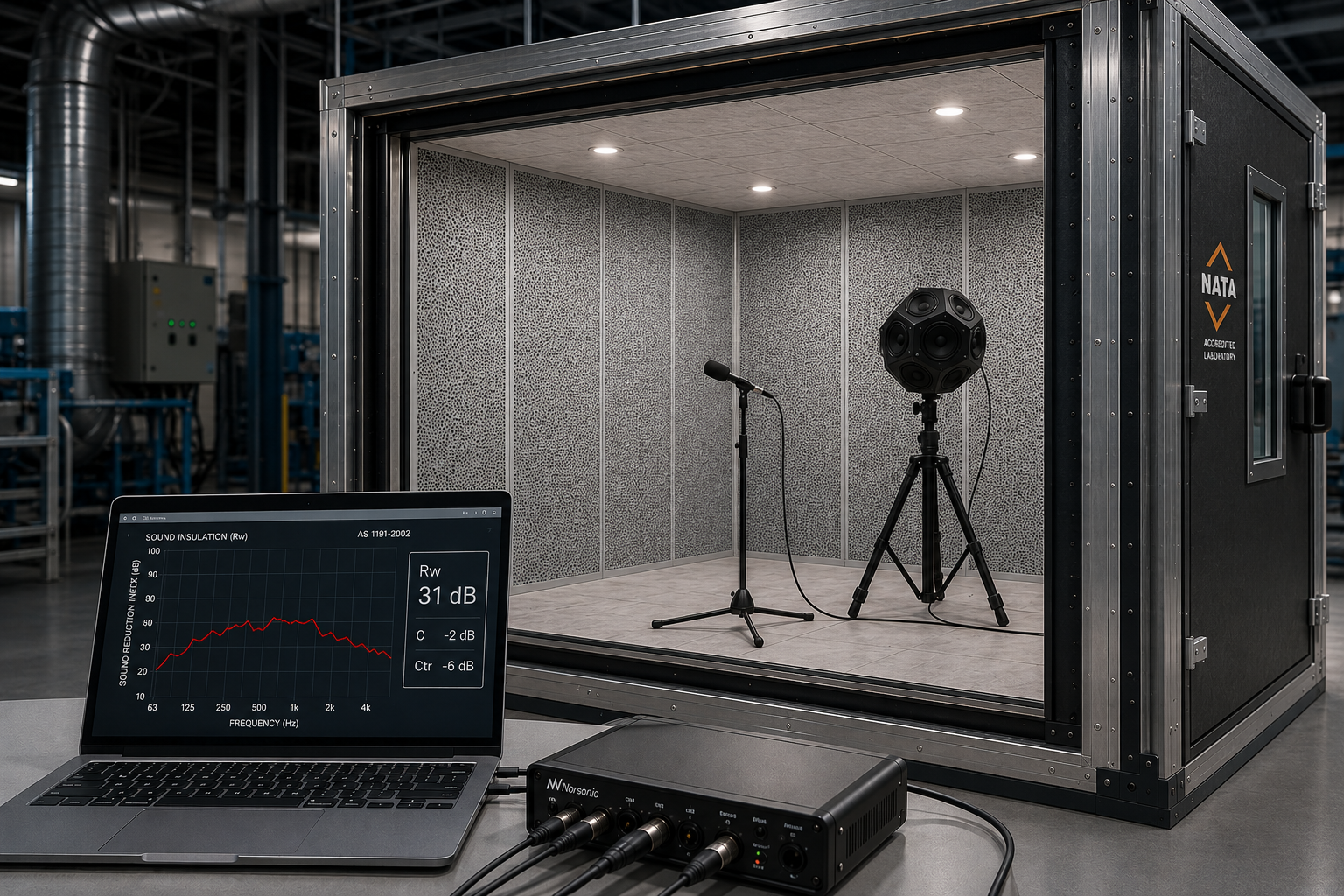
When acoustic testing is conducted in a NATA-accredited facility, the results carry formal recognition that the testing methodology met the required standard. For acoustic products, this typically means testing against Australian Standards such as AS 1191 for airborne sound insulation, or equivalent international standards.
The resulting performance figures – such as Rw (weighted sound reduction index) – are reproducible, comparable across products, and suitable for use in technical specifications and compliance documentation.
Many acoustic products are sold with performance claims that have no independent testing behind them. Yet estimated values, manufacturer-calculated figures, or results extrapolated from similar products give project teams no reliable basis for specification.
If a product underperforms after installation, there is no data to reference and no basis for a technical response. For projects where development approvals, EPA requirements, or building consents reference specific noise limits, the absence of verified performance data can create serious complications.
NATA-accredited test results provide a documented performance baseline. They give specifiers confidence that the product will perform to the stated level, and they create a clear paper trail if performance is questioned after installation.
Not all acoustic performance figures carry equal weight. When reviewing product documentation, look for:
Reference to NATA-accredited laboratory testing, a named testing facility and the standard used, Rw values expressed in the standard format (for example, Rw 37dB), and confirmation that the tested product is the same product being specified, not a representative or similar sample.
Performance ranges without a specific test reference, brand-calculated figures, or results from non-accredited testing are not equivalent to independently verified data. A product with properly tested performance will name the laboratory, cite the standard, and be able to provide the test report on request.
All Sonic System acoustic modular panels carry NATA-accredited laboratory test results for Rw ratings. The V50 panel achieves Rw 31dB, our V100 panel achieves Rw 37dB, and the V100SP panel achieves Rw 45dB. Each result reflects a fire-rated panel construction with FRL -/120/-.
Sonic acoustic curtain products are independently tested by the RMIT University Applied Acoustics Laboratory to AS 1191-2002 and AS/NZS ISO 717.1-2004 under NATA-accredited laboratory conditions. The 4kg Sonic Curtain achieves Rw 27dB, while the 6kg achieves Rw 30dB.
Sonic Access acoustic doors are independently tested, with single-leaf configurations achieving Rw 46dB and double-leaf configurations achieving Rw 45dB. High-performance single-leaf doors achieve Rw 52dB.
Having NATA-accredited test data across the product range means engineers and acoustic consultants can specify with confidence and quote accurate performance figures in project documentation.
A product with independently verified test data is a fundamentally different specification risk from one without. When a project has acoustic targets to meet, using products with NATA-accredited results reduces the chance of performance surprises after installation.
For consultants preparing acoustic reports, specifiers writing tender documentation, and project managers reviewing product submissions, NATA-accredited test results are the most reliable basis for acoustic specification decisions in Australia.
If a supplier cannot provide accredited test documentation for the specific product being specified, that is useful information before committing to a product selection.
Before you specify, talk to Flexshield about NATA-accredited industrial noise control
If you’d like to find out more about the importance of NATA-accredited acoustic performance testing and how it applies to your project, we invite you to contact Flexshield’s industrial noise control experts.
We’ll be happy to walk you through our industrial noise control solutions and assist your team in specifying the ideal solution for your facility.
We’ll make sure it’s built right from the start. For technical datasheets with full NATA-accredited acoustic performance data, contact Flexshield on 1300 799 969 or get in touch online.
Proudly built by Flexshield Group
Designed to perform. Built to last.