Call 1300 799 969 | Contact Us
Home » How acoustic testing works for industrial noise control projects
Acoustic test results appear on almost every product data sheet in the noise control industry. Rw values, NRC ratings, fire level ratings – the numbers are everywhere. But understanding what they represent, how they were obtained, and how they apply to your project is what separates a well-specified system from one that falls short.
This article explains how acoustic testing works, what different test ratings measure, and why the source of that testing matters when you are making specification decisions.
Noise control products are sold on performance claims. Without independent testing, those claims are difficult to verify. A product described as high performance may have been measured in favourable conditions, tested using non-standard methods, or rated using criteria that do not reflect how the product will actually behave in your application.
Independent laboratory testing removes this uncertainty. It provides a consistent, repeatable measurement of acoustic performance under defined conditions. When a specification requires tested acoustic performance, it gives the project team confidence that the product will perform as described.
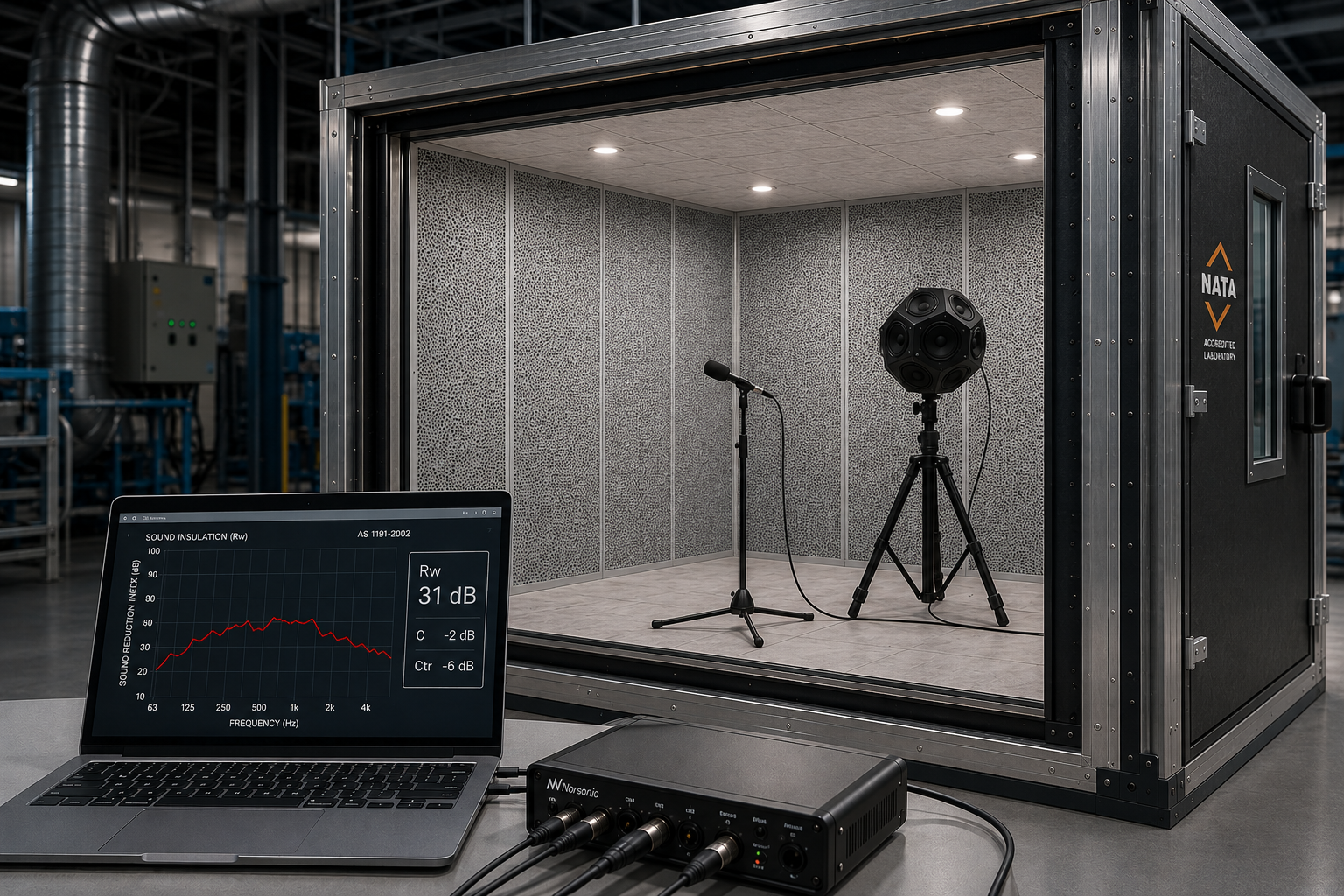
For Australian industrial projects, testing conducted under NATA-accredited laboratory conditions is the benchmark. NATA (the National Association of Testing Authorities) operates an accreditation system that verifies laboratories are competent to conduct specific types of testing. Products tested in NATA-accredited facilities are held to a standard that can be checked and verified.
Rw refers to weighted sound reduction index. It is the primary rating used to describe how much airborne sound a building element or acoustic product reduces when sound passes through it.
The Rw value is a single number derived from measurements across a range of frequencies. It reflects the overall sound insulation performance of the product, weighted to reflect how human hearing responds to different frequencies. A higher Rw means greater sound reduction.
Rw is used to rate panels, walls, doors, louvres, and other products intended to block or reduce the transmission of airborne noise. When comparing products, Rw allows a direct performance comparison provided the testing has been conducted under the same standard.
NRC stands for noise reduction coefficient. Where Rw describes sound transmission (how much sound passes through a product), NRC describes sound absorption (how much sound energy a surface absorbs rather than reflecting).
NRC is expressed as a value between 0 and 1, or occasionally above 1 due to edge effects in testing. A value of 1.00 represents complete absorption across the measured frequency range. Products with high NRC ratings are used to reduce reverberation inside a space rather than to block sound from passing between spaces.
Both ratings matter in industrial applications. A noise enclosure, for example, may need panels with both high Rw (to prevent sound escape) and high NRC (to reduce reflections and buildup inside the enclosure).
Acoustic testing is conducted in purpose-built facilities designed to minimise external interference and provide consistent measurement conditions. For transmission testing (Rw), a test specimen is installed between two rooms: a source room and a receiving room. Sound is generated in the source room and measured in both rooms. The difference in sound levels, adjusted for the receiving room absorption, produces the transmission loss data used to calculate the Rw value.
For absorption testing (NRC), the test specimen is placed in a reverberant chamber. The rate at which sound energy decays in the room is measured with and without the specimen, and the difference is used to calculate the absorption coefficients at each frequency.
Both tests are conducted at multiple frequencies, producing a frequency-response curve. The single-number Rw or NRC rating is derived from that curve using a standardised calculation method.
You’ll often see Rw values expressed with additional correction terms, written as Rw (C;Ctr). The C term adjusts for medium-frequency noise typical of speech, traffic, and machinery. The Ctr term adjusts for low-frequency noise, including traffic, heavy machinery, and bass-heavy mechanical plant.
For most industrial applications, the Ctr value is relevant. Industrial noise sources often produce significant low-frequency energy, which is harder to attenuate than mid or high-frequency noise. A product with a good Rw but a large negative Ctr correction may underperform against low-frequency industrial sources.
When reviewing product data, look at the full Rw (C;Ctr) expression rather than the headline Rw figure alone.
Laboratory testing establishes the acoustic performance of a product under controlled conditions. Site conditions are different. Flanking paths, installation quality, gaps, penetrations, and the acoustic characteristics of the surrounding structure all affect real-world acoustic performance.
This does not make laboratory data irrelevant. It provides a known starting point. A product tested to Rw 37dB will perform closer to Rw 37dB on site than an untested product claiming the same value. The test result tells you what the product is capable of achieving when properly installed.
For critical applications, an acoustic consultant will assess site conditions and advise on what installed performance is achievable based on the laboratory data. The tested Rw is an input to that assessment, not a guaranteed site outcome.
Sonic System acoustic modular panels are independently tested. The V50 panel is rated Rw 31dB, the V100 is rated Rw 37dB, and the V100SP is rated Rw 45dB. Each panel type also carries a fire rating of -/120/-.
Sonic Curtain products are tested by RMIT University Applied Acoustics Laboratory to AS 1191-2002 and AS/NZS ISO 717.1-2004 under NATA-accredited laboratory conditions. The 4kg Sonic Curtain achieves Rw 27dB, while the 6kg Sonic Curtain achieves Rw 30dB.
Sonic Series acoustic louvres are independently tested, with models ranging from Rw 18dB to Rw 33dB depending on the specification. Sonic Access acoustic doors are tested to Rw 46dB for single leaf, Rw 45dB for double leaf, and Rw 52dB for high performance configurations.
All performance figures are available from the Flexshield technical team for project review and specification.
When you’re evaluating acoustic products for an industrial project, these are the questions worth asking:
Products tested to ISO or EN standards are generally comparable to those tested under Australian standards for Rw purposes, though it’s worth confirming with your acoustic consultant on projects with specific compliance requirements.
If a supplier cannot provide an independent test report, treat the performance claim as unverified.
For many industrial applications, acoustic performance alone is not enough. Fire ratings are equally important, particularly in enclosed or partially enclosed environments.
Flexshield Sonic System panels carry a fire rating of -/120/- under AS 1530.4. This means the panels provide 120 minutes of fire resistance for integrity and insulation. Products installed in facilities with fire safety obligations should be specified with verified fire ratings, not assumed performance.
Acoustic testing provides the factual basis for product specification. Understanding what Rw and NRC measure, how those values are obtained, and how they apply to a real project helps engineers, consultants, and project managers make informed specification decisions.
Independent testing conducted under NATA-accredited or equivalent laboratory conditions is the standard worth requiring. When the test data is credible, the specification is credible.
The Flexshield team can provide full technical documentation and test reports for all Sonic System products. Talk to us about the acoustic performance requirements for your project.
We’ll make sure it’s built right from the start. Contact Flexshield on 1300 799 969 or get in touch online.
Proudly built by Flexshield Group
Designed to perform. Built to last.