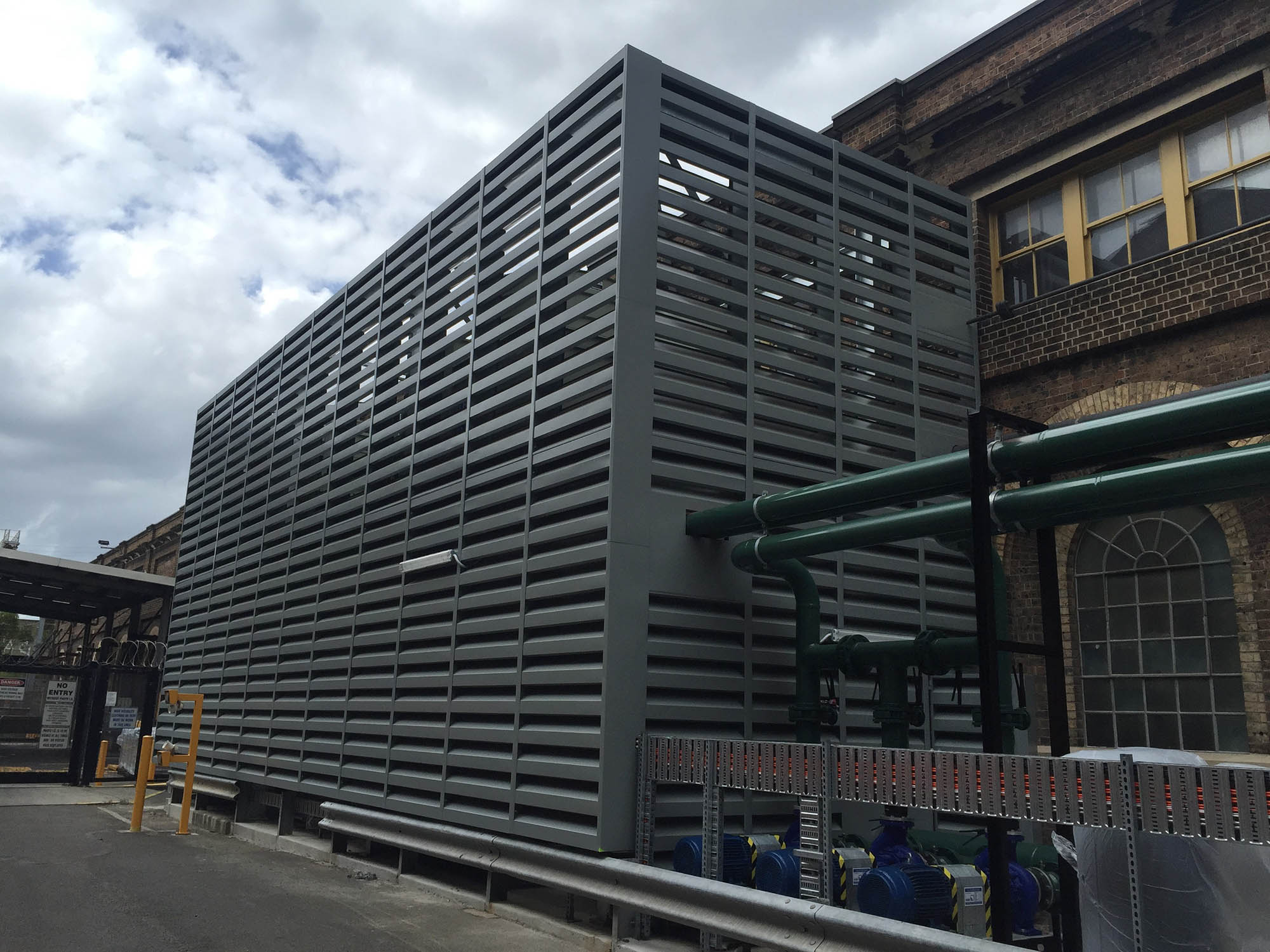

Sonic Series acoustic louvres are independently tested for acoustic performance to AS 1191:2002 (R2016). Weighted sound reduction (Rw) is determined to ISO 717.1:2004. The standard range covers Rw 18 to Rw 33.
Octave band sound reduction data from 125 Hz to 4 kHz is available for all seven standard models. This allows acoustic consultants to verify model selection against the project noise spectrum, rather than relying on the single-figure Rw rating alone.
Full test documentation is available on request.
Airflow performance for all Sonic Series models has been tested to AS/NZS 4740:2000. Test data includes free open area (FOA%), discharge coefficient (Cd) and pressure drop at face velocities from 0.5 to 3.0 m/s.
Free open area ranges from 21% to 35% across the standard range. Pressure drop and Cd data allows mechanical engineers to calculate the impact of louvre selection on ventilation system performance.
Airflow class ratings (Class 1 or Class 2 per AS/NZS 4740:2000) are available for all standard models.
Rain penetration for all Sonic Series standard models has been independently tested to AS/NZS 4740:2000, Appendix B, at a rain flow rate of 75 L/h·m².
Six models achieve Class C rain penetration ratings. The SL4-10 achieves Class D. Detailed penetration rate data at each test face velocity is available from test documentation on request.
Sonic Series acoustic louvres are assembled from interlocking pre-galvanised mild steel modules. The acoustic fill is non-combustible and vermin-proof. A detachable galvanised bird screen is fitted as standard. Insect screens are available.
Maximum single module size is 2400mm wide by 3000mm high. Multi-section assemblies cover openings of almost any configuration. The interlocking system allows installation with standard site equipment.
Sonic Series acoustic louvres are manufactured in Australia. Standard configurations are available without the lead times associated with imported products. Module sizes and configurations can be adjusted during the project rather than committed to months in advance.
Local engineering support is available for technical queries during specification, procurement and installation.
Test certificates, performance data sheets and specification templates are available for all Sonic Series models. These can be provided in formats suitable for acoustic consultant reports, project specifications and building certification submissions.
Contact Flexshield for specification support: 1300 799 969 | enquiry@flexshield.com.au
Sonic Series acoustic louvres control noise at ventilation openings while maintaining required airflow. Seven standard configurations are independently tested from Rw 18 to Rw 33, covering the range of acoustic design requirements encountered in industrial, infrastructure, resources, government and commercial projects.
All models are tested for acoustic performance, airflow resistance and rain penetration. Tested data — including octave band sound reduction, pressure drop at face velocities from 0.5 to 3.0 m/s and rain penetration class — is available in the tabs below and in full test documentation on request.
Sonic Series acoustic louvres are manufactured in Australia in pre-galvanised mild steel, stainless steel, aluminium and powder-coated finishes. Standard modules are available up to 2400mm wide by 3000mm high. Additional acoustic louvre configurations are available upon request.
Compare acoustic performance, free open area and weather performance across the SL4 Sonic Series acoustic louvre range. Expand each model below for detailed specifications and typical applications.
All data tested to AS 1191:2002 (R2016) and ISO 717.1:2004.
| Model | Rw (C;Ctr) | 125 Hz | 250 Hz | 500 Hz | 1 kHz | 2 kHz | 4 kHz | FOA % | Rain Class |
| SL4-10 | 18 (−1;−2) | 10 | 12 | 15 | 18 | 21 | 21 | 22% | Class D |
| SL4-20 | 20 (−1;−2) | 10 | 12 | 16 | 21 | 21 | 22 | 21% | Class C |
| SL4-20C | 29 (−1;−5) | 12 | 21 | 27 | 30 | 31 | 30 | 29% | Class C |
| SL4-30 | 27 (−2;−5) | 11 | 19 | 24 | 27 | 28 | 28 | 35% | Class C |
| SL4-30C | 31 (−1;−5) | 12 | 26 | 29 | 31 | 33 | 32 | 35% | Class C |
| SL4-45C | 29 (−1;−3) | 17 | 21 | 26 | 29 | 31 | 31 | 35% | Class C |
| SL4-60C | 33 (−1;−4) | 20 | 27 | 30 | 32 | 35 | 36 | 35% | Class C |
Sound reduction data (dB) at 1/1 octave band centre frequencies. Tested to AS 1191:2002 (R2016) and ISO 717.1:2004. Full test documentation available on request.
The SL4-10 is a 100mm depth single-blade acoustic louvre providing Rw 18 and 22% free open area.
| Rw | FOA | Cd | Airflow Class | Rain Class |
| 18 (−1;−2) | 22% | 0.877 | Class 1 | Class D |
Typical applications: Car park ventilation, substation ventilation, low-noise plant room openings and building facade openings where airflow takes priority over acoustic performance.
The SL4-20 is a 200mm depth single-blade acoustic louvre providing Rw 20 and 21% free open area. It provides a step up in acoustic performance from the SL4-10 within a 200mm blade depth.
| Rw | FOA | Cd | Airflow Class | Rain Class |
| 20 (−1;−2) | 21% | 0.77 | Class 1 | Class C |
Typical applications: Air handling unit intake and exhaust openings, mechanical plant rooms, commercial HVAC installations and building facade ventilation.
The SL4-20C is a 200mm depth chevron-blade acoustic louvre providing Rw 29 and 29% free open area. The chevron blade configuration substantially increases acoustic performance relative to the single-blade SL4-20 within the same 200mm depth.
| Rw | FOA | Cd | Airflow Class | Rain Class |
| 29 (−1;−5) | 29% | 0.50 | Class 2 | Class C |
Typical applications: Generator enclosure ventilation, cooling tower installations, plant rooms with moderate to high acoustic design requirements and mechanical services openings where blade depth is limited.
The SL4-30 is a 300mm depth single-blade acoustic louvre providing Rw 27 and 35% free open area. With a Class 1 airflow discharge coefficient of 0.82, it suits installations where airflow capacity is required alongside moderate acoustic attenuation.
| Rw | FOA | Cd | Airflow Class | Rain Class |
| 27 (−2;−5) | 35% | 0.82 | Class 1 | Class C |
Typical applications: Cooling tower ventilation, industrial plant room openings, mechanical services openings and building facades where both ventilation volume and acoustic performance must be met.
The SL4-30C is a 300mm depth chevron-blade acoustic louvre providing Rw 31 and 35% free open area. It is the highest-performing 300mm model in the standard range.
| Rw | FOA | Cd | Airflow Class | Rain Class |
| 31 (−1;−5) | 35% | 0.53 | Class 2 | Class C |
Typical applications: Generator rooms, pump stations, compressor enclosures and industrial plant rooms with acoustic design requirements in the Rw 29–31 range.
The SL4-45C is a 450mm depth acoustic louvre providing Rw 29 and 35% free open area. It provides superior low-frequency attenuation compared with the SL4-20C while maintaining higher airflow performance.
| Rw | FOA | Cd | Airflow Class | Rain Class |
| 29 (−1;−3) | 35% | 0.80 | Class 1 | Class C |
Typical applications: Plant room ventilation where low-frequency noise content is present, cooling tower applications, industrial mechanical services openings and industrial facades.
The SL4-60C is a 600mm depth acoustic louvre providing Rw 33 and 35% free open area. It is the highest-performing model in the standard range and is suited to the most demanding acoustic design requirements.
| Rw | FOA | Cd | Airflow Class | Rain Class |
| 33 (−1;−4) | 35% | 0.83 | Class 1 | Class C |
Typical applications: Generator enclosures, data centres, industrial plant rooms, pump stations and infrastructure installations with high acoustic design requirements.
Test standard: AS/NZS 4740:2000, Appendix B. Rain flow rate: 75 L/h·m². Average effectiveness is the mean across all test face velocities.
| Component | Specification |
| Casing and frame | Pre-galvanised mild steel |
| Casing thickness (up to 1500mm) | 1.0mm |
| Casing thickness (above 1500mm) | 1.2mm |
| Maximum single module size | 2400mm W × 3000mm H |
| Multi-section assemblies | No practical size limit |
| Acoustic fill | Non-combustible, vermin-proof mineral wool |
| Weather stop | Inhibits rain and snow ingress, fitted as standard |
| Bird screen | Detachable galvanised, fitted as standard |
| Insect screens | Available on request |
| Finish | Application |
| Galvanised mild steel | Standard industrial finish |
| Powder-coat | Custom colours, architectural and facade applications |
| Stainless steel | Corrosive and marine environments |
| Aluminium | Lightweight and corrosion-resistant applications |
| Colorbond | Facade integration |
Supply and install Flexshield Sonic Series Acoustic Louvres. Finish: [specify finish and colour].
NR – Noise Reduction/IL – Insertion Loss (dB) 125, 250, 500, 1K, 2K, 4K
Phone: 1300 799 969
Email: enquiry@flexshield.com.au
Fabricated and installed to the manufacturer’s specifications. Qty and sizes found on drawing numbers: _________
Test standard: AS 1191:2002 (R2016). Rw determined to ISO 717.1:2004. Sound reduction index (R) in dB at 1/1 octave band centre frequencies.
| Model | Rw (C;Ctr) | 125 Hz | 250 Hz | 500 Hz | 1 kHz | 2 kHz | 4 kHz | FOA % | Rain class |
| SL4-10 | 18 (−1;−2) | 10 | 12 | 15 | 18 | 21 | 21 | 22% | Class D |
| SL4-20 | 20 (−1;−2) | 10 | 12 | 16 | 21 | 21 | 22 | 21% | Class C |
| SL4-20C | 29 (−1;−5) | 12 | 21 | 27 | 30 | 31 | 30 | 29% | Class C |
| SL4-30 | 27 (−2;−5) | 11 | 19 | 24 | 27 | 28 | 28 | 35% | Class C |
| SL4-30C | 31 (−1;−5) | 12 | 26 | 29 | 31 | 33 | 32 | 35% | Class C |
| SL4-45C | 29 (−1;−3) | 17 | 21 | 26 | 29 | 31 | 31 | 35% | Class C |
| SL4-60C | 33 (−1;−4) | 20 | 27 | 30 | 32 | 35 | 36 | 35% | Class C |
Full test documentation available on request. FOA = free open area. C and Ctr are spectrum adaptation terms.
Test standard: AS/NZS 4740:2000. FOA = free open area. Cd = discharge coefficient. Airflow class per AS/NZS 4740:2000.
| Model | FOA % | Cd | Airflow Class | EFA m² (1m x 1m module) |
| SL4-10 | 22% | 0.877 | Class 1 | 0.20 |
| SL4-20 | 21% | 0.77 | Class 1 | 0.16 |
| SL4-20C | 29% | 0.50 | Class 2 | 0.14 |
| SL4-30 | 35% | 0.82 | Class 1 | 0.29 |
| SL4-30C | 35% | 0.53 | Class 2 | 0.18 |
| SL4-45C | 35% | 0.80 | Class 1 | 0.28 |
| SL4-60C | 35% | 0.83 | Class 1 | 0.29 |
EFA (effective free area) calculated for a 1m x 1m module. Tested to AS/NZS 4740:2000.
Test standard: AS/NZS 4740:2000. Pressure drop measured at the stated face velocities.
| Model | 0.5 m/s | 1.0 m/s | 1.5 m/s | 2.0 m/s | 2.5 m/s | 3.0 m/s |
| SL4-10 | 5 | 20 | 45 | 80 | 126 | 182 |
| SL4-20 | 12 | 48 | 107 | 190 | 300 | 430 |
| SL4-20C | 10 | 40 | 91 | 162 | 252 | 365 |
| SL4-30 | 3.5 | 15 | 32 | 57 | 90 | 128 |
| SL4-30C | 6.5 | 25 | 57 | 100 | 160 | 228 |
| SL4-45C | 5 | 19 | 43 | 77 | 120 | 172 |
| SL4-60C | 4.5 | 18 | 41 | 74 | 113 | 164 |
All values in Pascals (Pa). Tested to AS/NZS 4740:2000. Full dataset available on request.
Test standard: AS/NZS 4740:2000, Appendix B. Rain flow rate: 75 L/h·m².
| Model | Rain Class | Avg Effectiveness | Notes |
| SL4-10 | Class D | 0.744 | Some penetration at all test velocities. |
| SL4-20 | Class C | 0.865 | Low penetration at low velocities. |
| SL4-20C | Class C | 0.917 | Minimal penetration below 2 m/s. |
| SL4-30 | Class C | 0.886 | Good rain resistance at lower velocities. |
| SL4-30C | Class C | 0.918 | Zero penetration at 0–1 m/s. |
| SL4-45C | Class C | 0.860 | Consistent performance across range. |
| SL4-60C | Class C | 0.946 | Highest average effectiveness. |
Detailed penetration data available on request.
Sonic Series acoustic louvres are independently tested for acoustic performance to AS 1191:2002 (R2016). Weighted sound reduction (Rw) is determined to ISO 717.1:2004. The standard range covers Rw 18 to Rw 33.
Octave band sound reduction data from 125 Hz to 4 kHz is available for all seven standard models. This allows acoustic consultants to verify model selection against the project noise spectrum, rather than relying on the single-figure Rw rating alone.
Full test documentation is available on request.
Airflow performance for all Sonic Series models has been tested to AS/NZS 4740:2000. Test data includes free open area (FOA%), discharge coefficient (Cd) and pressure drop at face velocities from 0.5 to 3.0 m/s.
Free open area ranges from 21% to 35% across the standard range. Pressure drop and Cd data allows mechanical engineers to calculate the impact of louvre selection on ventilation system performance.
Airflow class ratings (Class 1 or Class 2 per AS/NZS 4740:2000) are available for all standard models.
Rain penetration for all Sonic Series standard models has been independently tested to AS/NZS 4740:2000, Appendix B, at a rain flow rate of 75 L/h·m².
Six models achieve Class C rain penetration ratings. The SL4-10 achieves Class D. Detailed penetration rate data at each test face velocity is available from test documentation on request.
Sonic Series acoustic louvres are assembled from interlocking pre-galvanised mild steel modules. The acoustic fill is non-combustible and vermin-proof. A detachable galvanised bird screen is fitted as standard. Insect screens are available.
Maximum single module size is 2400mm wide by 3000mm high. Multi-section assemblies cover openings of almost any configuration. The interlocking system allows installation with standard site equipment.
Sonic Series acoustic louvres are manufactured in Australia. Standard configurations are available without the lead times associated with imported products. Module sizes and configurations can be adjusted during the project rather than committed to months in advance.
Local engineering support is available for technical queries during specification, procurement and installation.
Test certificates, performance data sheets and specification templates are available for all Sonic Series models. These can be provided in formats suitable for acoustic consultant reports, project specifications and building certification submissions.
Contact Flexshield for specification support: 1300 799 969 | enquiry@flexshield.com.au
Sonic Series acoustic louvres control noise at ventilation openings while maintaining required airflow. Seven standard configurations are independently tested from Rw 18 to Rw 33, covering the range of acoustic design requirements encountered in industrial, infrastructure, resources, government and commercial projects.
All models are tested for acoustic performance, airflow resistance and rain penetration. Tested data — including octave band sound reduction, pressure drop at face velocities from 0.5 to 3.0 m/s and rain penetration class — is available in the tabs below and in full test documentation on request.
Sonic Series acoustic louvres are manufactured in Australia in pre-galvanised mild steel, stainless steel, aluminium and powder-coated finishes. Standard modules are available up to 2400mm wide by 3000mm high. Additional acoustic louvre configurations are available upon request.
Compare acoustic performance, free open area and weather performance across the SL4 Sonic Series acoustic louvre range. Expand each model below for detailed specifications and typical applications.
All data tested to AS 1191:2002 (R2016) and ISO 717.1:2004.
| Model | Rw (C;Ctr) | 125 Hz | 250 Hz | 500 Hz | 1 kHz | 2 kHz | 4 kHz | FOA % | Rain Class |
| SL4-10 | 18 (−1;−2) | 10 | 12 | 15 | 18 | 21 | 21 | 22% | Class D |
| SL4-20 | 20 (−1;−2) | 10 | 12 | 16 | 21 | 21 | 22 | 21% | Class C |
| SL4-20C | 29 (−1;−5) | 12 | 21 | 27 | 30 | 31 | 30 | 29% | Class C |
| SL4-30 | 27 (−2;−5) | 11 | 19 | 24 | 27 | 28 | 28 | 35% | Class C |
| SL4-30C | 31 (−1;−5) | 12 | 26 | 29 | 31 | 33 | 32 | 35% | Class C |
| SL4-45C | 29 (−1;−3) | 17 | 21 | 26 | 29 | 31 | 31 | 35% | Class C |
| SL4-60C | 33 (−1;−4) | 20 | 27 | 30 | 32 | 35 | 36 | 35% | Class C |
Sound reduction data (dB) at 1/1 octave band centre frequencies. Tested to AS 1191:2002 (R2016) and ISO 717.1:2004. Full test documentation available on request.
The SL4-10 is a 100mm depth single-blade acoustic louvre providing Rw 18 and 22% free open area.
| Rw | FOA | Cd | Airflow Class | Rain Class |
| 18 (−1;−2) | 22% | 0.877 | Class 1 | Class D |
Typical applications: Car park ventilation, substation ventilation, low-noise plant room openings and building facade openings where airflow takes priority over acoustic performance.
The SL4-20 is a 200mm depth single-blade acoustic louvre providing Rw 20 and 21% free open area. It provides a step up in acoustic performance from the SL4-10 within a 200mm blade depth.
| Rw | FOA | Cd | Airflow Class | Rain Class |
| 20 (−1;−2) | 21% | 0.77 | Class 1 | Class C |
Typical applications: Air handling unit intake and exhaust openings, mechanical plant rooms, commercial HVAC installations and building facade ventilation.
The SL4-20C is a 200mm depth chevron-blade acoustic louvre providing Rw 29 and 29% free open area. The chevron blade configuration substantially increases acoustic performance relative to the single-blade SL4-20 within the same 200mm depth.
| Rw | FOA | Cd | Airflow Class | Rain Class |
| 29 (−1;−5) | 29% | 0.50 | Class 2 | Class C |
Typical applications: Generator enclosure ventilation, cooling tower installations, plant rooms with moderate to high acoustic design requirements and mechanical services openings where blade depth is limited.
The SL4-30 is a 300mm depth single-blade acoustic louvre providing Rw 27 and 35% free open area. With a Class 1 airflow discharge coefficient of 0.82, it suits installations where airflow capacity is required alongside moderate acoustic attenuation.
| Rw | FOA | Cd | Airflow Class | Rain Class |
| 27 (−2;−5) | 35% | 0.82 | Class 1 | Class C |
Typical applications: Cooling tower ventilation, industrial plant room openings, mechanical services openings and building facades where both ventilation volume and acoustic performance must be met.
The SL4-30C is a 300mm depth chevron-blade acoustic louvre providing Rw 31 and 35% free open area. It is the highest-performing 300mm model in the standard range.
| Rw | FOA | Cd | Airflow Class | Rain Class |
| 31 (−1;−5) | 35% | 0.53 | Class 2 | Class C |
Typical applications: Generator rooms, pump stations, compressor enclosures and industrial plant rooms with acoustic design requirements in the Rw 29–31 range.
The SL4-45C is a 450mm depth acoustic louvre providing Rw 29 and 35% free open area. It provides superior low-frequency attenuation compared with the SL4-20C while maintaining higher airflow performance.
| Rw | FOA | Cd | Airflow Class | Rain Class |
| 29 (−1;−3) | 35% | 0.80 | Class 1 | Class C |
Typical applications: Plant room ventilation where low-frequency noise content is present, cooling tower applications, industrial mechanical services openings and industrial facades.
The SL4-60C is a 600mm depth acoustic louvre providing Rw 33 and 35% free open area. It is the highest-performing model in the standard range and is suited to the most demanding acoustic design requirements.
| Rw | FOA | Cd | Airflow Class | Rain Class |
| 33 (−1;−4) | 35% | 0.83 | Class 1 | Class C |
Typical applications: Generator enclosures, data centres, industrial plant rooms, pump stations and infrastructure installations with high acoustic design requirements.
Test standard: AS/NZS 4740:2000, Appendix B. Rain flow rate: 75 L/h·m². Average effectiveness is the mean across all test face velocities.
| Component | Specification |
| Casing and frame | Pre-galvanised mild steel |
| Casing thickness (up to 1500mm) | 1.0mm |
| Casing thickness (above 1500mm) | 1.2mm |
| Maximum single module size | 2400mm W × 3000mm H |
| Multi-section assemblies | No practical size limit |
| Acoustic fill | Non-combustible, vermin-proof mineral wool |
| Weather stop | Inhibits rain and snow ingress, fitted as standard |
| Bird screen | Detachable galvanised, fitted as standard |
| Insect screens | Available on request |
| Finish | Application |
| Galvanised mild steel | Standard industrial finish |
| Powder-coat | Custom colours, architectural and facade applications |
| Stainless steel | Corrosive and marine environments |
| Aluminium | Lightweight and corrosion-resistant applications |
| Colorbond | Facade integration |
Supply and install Flexshield Sonic Series Acoustic Louvres. Finish: [specify finish and colour].
NR – Noise Reduction/IL – Insertion Loss (dB) 125, 250, 500, 1K, 2K, 4K
Phone: 1300 799 969
Email: enquiry@flexshield.com.au
Fabricated and installed to the manufacturer’s specifications. Qty and sizes found on drawing numbers: _________
Test standard: AS 1191:2002 (R2016). Rw determined to ISO 717.1:2004. Sound reduction index (R) in dB at 1/1 octave band centre frequencies.
| Model | Rw (C;Ctr) | 125 Hz | 250 Hz | 500 Hz | 1 kHz | 2 kHz | 4 kHz | FOA % | Rain class |
| SL4-10 | 18 (−1;−2) | 10 | 12 | 15 | 18 | 21 | 21 | 22% | Class D |
| SL4-20 | 20 (−1;−2) | 10 | 12 | 16 | 21 | 21 | 22 | 21% | Class C |
| SL4-20C | 29 (−1;−5) | 12 | 21 | 27 | 30 | 31 | 30 | 29% | Class C |
| SL4-30 | 27 (−2;−5) | 11 | 19 | 24 | 27 | 28 | 28 | 35% | Class C |
| SL4-30C | 31 (−1;−5) | 12 | 26 | 29 | 31 | 33 | 32 | 35% | Class C |
| SL4-45C | 29 (−1;−3) | 17 | 21 | 26 | 29 | 31 | 31 | 35% | Class C |
| SL4-60C | 33 (−1;−4) | 20 | 27 | 30 | 32 | 35 | 36 | 35% | Class C |
Full test documentation available on request. FOA = free open area. C and Ctr are spectrum adaptation terms.
Test standard: AS/NZS 4740:2000. FOA = free open area. Cd = discharge coefficient. Airflow class per AS/NZS 4740:2000.
| Model | FOA % | Cd | Airflow Class | EFA m² (1m x 1m module) |
| SL4-10 | 22% | 0.877 | Class 1 | 0.20 |
| SL4-20 | 21% | 0.77 | Class 1 | 0.16 |
| SL4-20C | 29% | 0.50 | Class 2 | 0.14 |
| SL4-30 | 35% | 0.82 | Class 1 | 0.29 |
| SL4-30C | 35% | 0.53 | Class 2 | 0.18 |
| SL4-45C | 35% | 0.80 | Class 1 | 0.28 |
| SL4-60C | 35% | 0.83 | Class 1 | 0.29 |
EFA (effective free area) calculated for a 1m x 1m module. Tested to AS/NZS 4740:2000.
Test standard: AS/NZS 4740:2000. Pressure drop measured at the stated face velocities.
| Model | 0.5 m/s | 1.0 m/s | 1.5 m/s | 2.0 m/s | 2.5 m/s | 3.0 m/s |
| SL4-10 | 5 | 20 | 45 | 80 | 126 | 182 |
| SL4-20 | 12 | 48 | 107 | 190 | 300 | 430 |
| SL4-20C | 10 | 40 | 91 | 162 | 252 | 365 |
| SL4-30 | 3.5 | 15 | 32 | 57 | 90 | 128 |
| SL4-30C | 6.5 | 25 | 57 | 100 | 160 | 228 |
| SL4-45C | 5 | 19 | 43 | 77 | 120 | 172 |
| SL4-60C | 4.5 | 18 | 41 | 74 | 113 | 164 |
All values in Pascals (Pa). Tested to AS/NZS 4740:2000. Full dataset available on request.
Test standard: AS/NZS 4740:2000, Appendix B. Rain flow rate: 75 L/h·m².
| Model | Rain Class | Avg Effectiveness | Notes |
| SL4-10 | Class D | 0.744 | Some penetration at all test velocities. |
| SL4-20 | Class C | 0.865 | Low penetration at low velocities. |
| SL4-20C | Class C | 0.917 | Minimal penetration below 2 m/s. |
| SL4-30 | Class C | 0.886 | Good rain resistance at lower velocities. |
| SL4-30C | Class C | 0.918 | Zero penetration at 0–1 m/s. |
| SL4-45C | Class C | 0.860 | Consistent performance across range. |
| SL4-60C | Class C | 0.946 | Highest average effectiveness. |
Detailed penetration data available on request.
Bradley Clinch, Director | Exceptional Enclosures Pty Ltd.
We are proud to work with some of Australia’s greatest brands







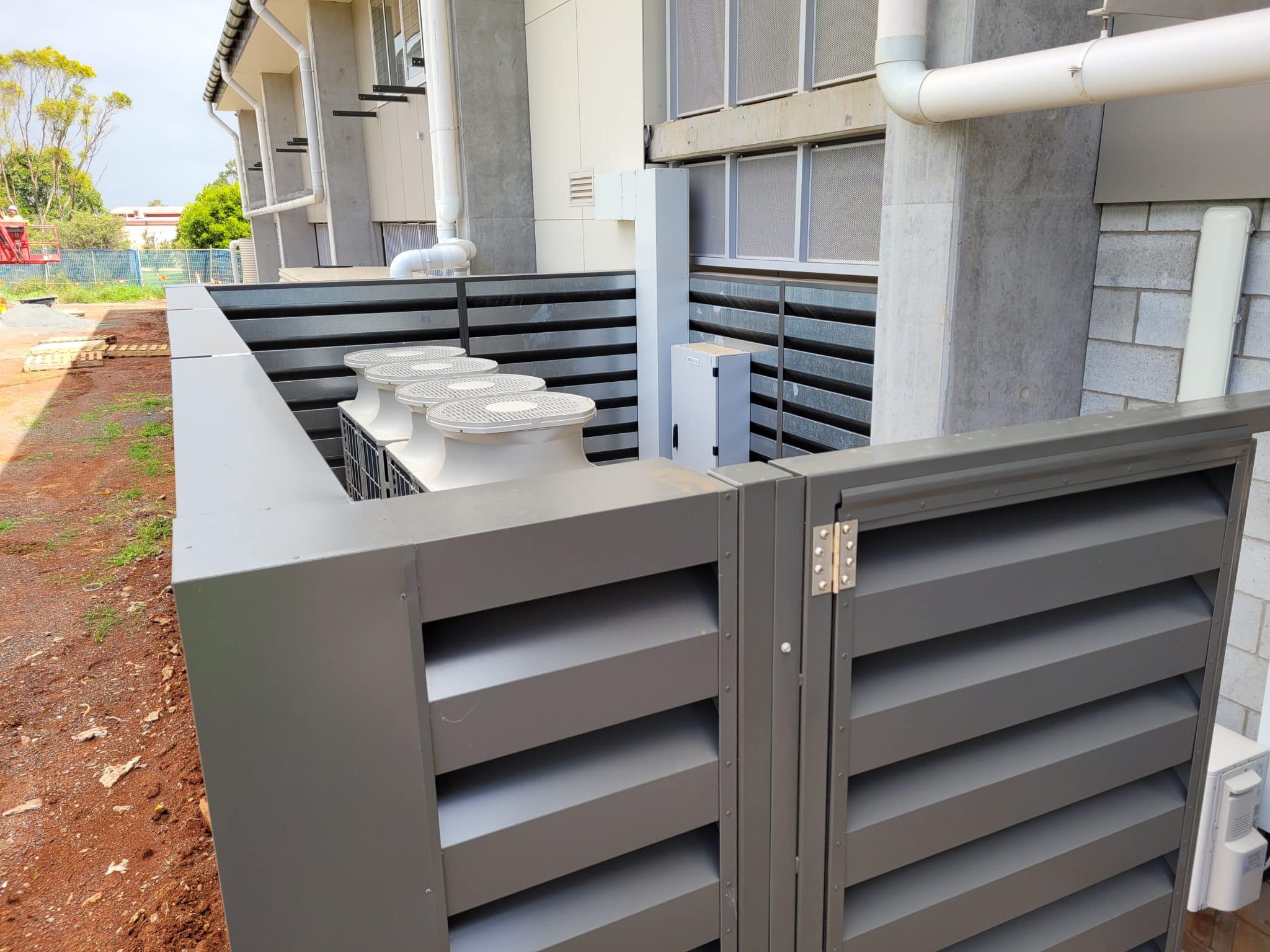
Project: Acoustic louvre enclosure solution
Industry: Construction/Education
Location: Toowoomba, QLD
Client: Bryant Building Contractors Pty Ltd
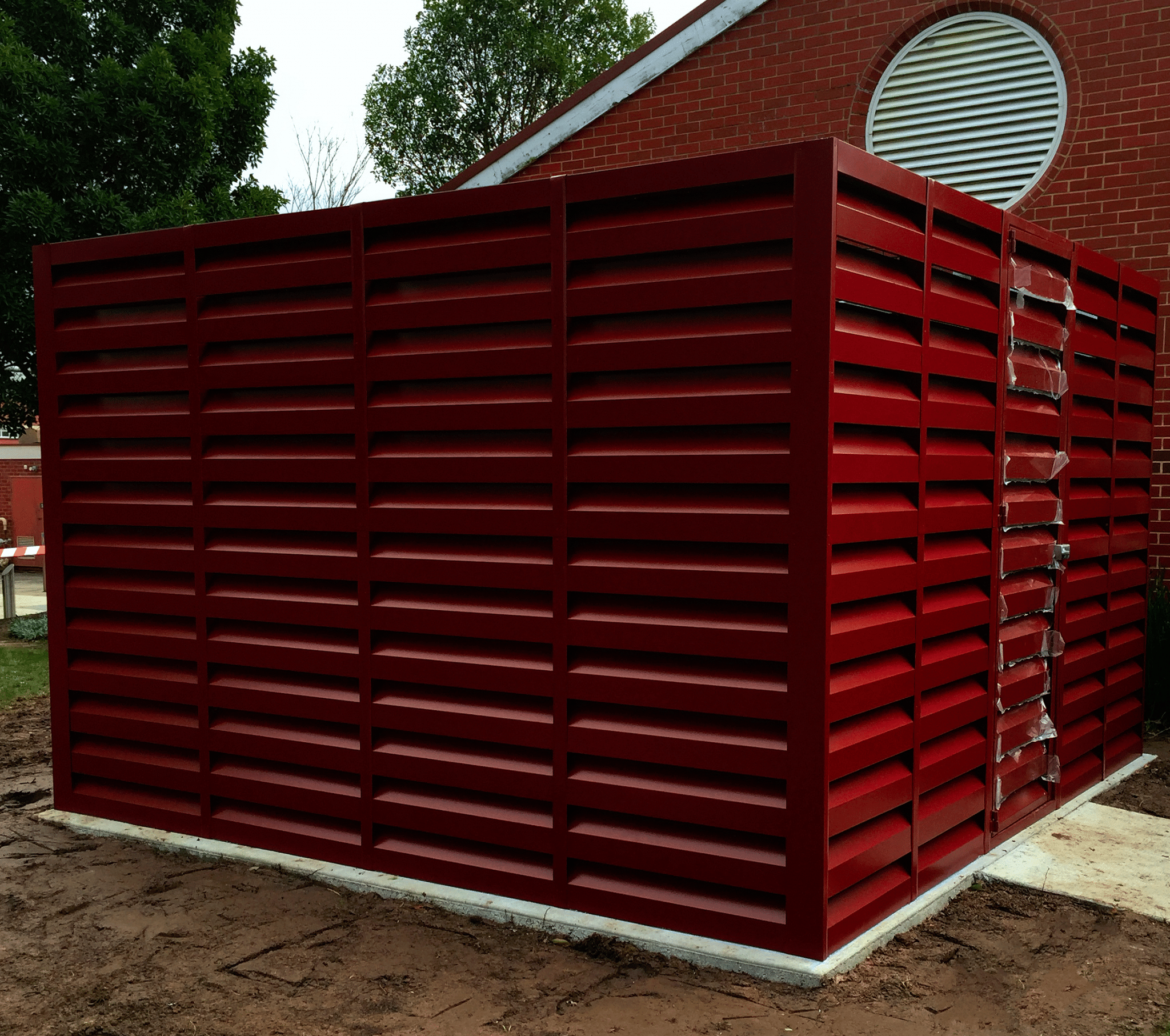
Project: Acoustic louvre enclosure for HMAS Cerberus
Industry: Defence | Construction
Location: HMAS Cerberus VIC
Client: Department of Defence
Lead times depend on project scope, configuration and programme requirements. Because Sonic Series acoustic louvres are manufactured in Australia, standard configurations are available without the lead times associated with offshore supply chains. Non-standard module sizes, specialised finishes and project-specific configurations can be accommodated during the project lifecycle rather than requiring early programme commitment.
For project-specific lead time estimates, contact Flexshield early in the programme. Early engagement allows configuration, finish and delivery to be confirmed before procurement deadlines.
Phone: 1300 799 969 | enquiry@flexshield.com.au
Sonic Series acoustic louvres require minimal maintenance under normal operating conditions. Recommended maintenance includes periodic visual inspection of the casing, blades and bird screen for physical damage or corrosion; cleaning of blade surfaces to remove accumulated dust or debris; inspection of weather stop seals and perimeter sealing; re-tightening of any loose fasteners; and reapplication of protective coating to areas showing early corrosion.
In coastal, marine or chemically aggressive environments, more frequent inspection may be appropriate.
The non-combustible acoustic fill is fully enclosed within the blade assembly and does not require maintenance under normal operating conditions.
Yes. In addition to the standard pre-galvanised mild steel finish, Sonic Series acoustic louvres are available in stainless steel, aluminium, Colorbond and powder coat in a range of colours. Material and finish selection depends on the environmental conditions at the installation location and any project aesthetic or specification requirements.
Acoustic louvre specification and installation is governed by the acoustic design requirements of the project rather than a single prescriptive installation standard.
The relevant framework typically includes:
The National Construction Code (NCC), which sets minimum performance requirements for sound and mechanical services in buildings.
AS/NZS 4740:2000, which is the primary test standard for acoustic louvre performance in Australia and New Zealand.
Project acoustic reports, which specify the required noise reduction (Rw or insertion loss) at each ventilation opening based on the noise source and receiver requirements.
State and local environmental protection legislation, which establishes the noise limits the acoustic design must achieve.
Flexshield provides test certificates and performance data in formats suitable for project documentation, council submissions and building certification.
Sonic Series acoustic louvres are regularly installed into existing openings as part of noise control upgrades and equipment enclosure projects.
Because they are manufactured in Australia, project-specific module sizes can be accommodated without the lead time penalties associated with imported product.
Retrofitting requires confirmation of opening dimensions, the structural attachment method and any changes to ventilation system pressure resulting from the introduction of the louvre. Flexshield can provide specification and engineering support for retrofit projects.
A single Sonic Series acoustic louvre module can be manufactured up to 2400mm wide by 3000mm high. Larger openings are served by multi-section assemblies, which can be configured to fill openings of almost any size.
Yes. Sonic Series acoustic louvres are regularly used in outdoor applications including generator enclosures, cooling tower installations, pump stations and building facades.
All models are manufactured in pre-galvanised mild steel with a non-combustible, vermin-proof acoustic fill and a weather stop to inhibit rain and snow ingress. Bird screens are fitted as standard. Insect screens are available.
For marine or chemically aggressive environments, stainless steel and aluminium options are available.
Where rain ingress is a design consideration, model selection should take the tested rain class and design face velocity into account alongside acoustic performance. Rain penetration test data is available for all standard models.
Rain penetration has been independently tested to AS/NZS 4740:2000, Appendix B, at a rain flow rate of 75 L/h·m².
SL4-10: Class D (average effectiveness 0.744). Some penetration occurs at all test face velocities.
SL4-20: Class C (average effectiveness 0.865).
SL4-20C: Class C (average effectiveness 0.917).
SL4-30: Class C (average effectiveness 0.886).
SL4-30C: Class C (average effectiveness 0.918). Zero penetration at 0–1 m/s.
SL4-45C: Class C (average effectiveness 0.860).
SL4-60C: Class C (average effectiveness 0.946). Best rain performance in the standard range.
Detailed penetration rate data at each test face velocity is available from test documentation on request.
AS/NZS 4740:2000 classifies acoustic louvre airflow performance as Class 1 or Class 2 based on the discharge coefficient (Cd).
Class 1 indicates a higher discharge coefficient (lower resistance to airflow) and is generally associated with single-blade or wide-pitch blade configurations. Class 2 indicates a lower discharge coefficient (higher resistance) and is associated with chevron blade configurations that provide higher acoustic performance at the cost of increased pressure drop.
In the Sonic Series standard range, SL4-20C and SL4-30C are Class 2. All other standard models are Class 1.
Acoustic performance (Rw and octave band data): AS 1191:2002 (R2016) and ISO 717.1:2004.
Airflow performance (FOA, discharge coefficient and pressure drop): AS/NZS 4740:2000.
Rain penetration: AS/NZS 4740:2000, Appendix B, at a rain flow rate of 75 L/h·m².
Full test certificates are available on request.
Selection depends on two primary inputs: the acoustic design requirement (expressed as Rw or as octave band insertion loss values from the acoustic consultant’s report) and the ventilation system constraint (available system pressure and required airflow at the design face velocity).
Start with the acoustic design requirement. Match the required Rw or octave band insertion loss against the performance data in the tables on this page. Where more than one model meets the acoustic requirement, compare the pressure drop at the design face velocity to identify which model is compatible with the ventilation system.
Where the project noise spectrum has significant low-frequency content, compare octave band data rather than relying on Rw alone. The SL4-45C, for example, provides better 125 Hz attenuation than the SL4-20C at the same Rw 29 rating.
Contact Flexshield for specification support: 1300 799 969 | enquiry@flexshield.com.au
Free open area (FOA) is the percentage of the louvre face area that is unobstructed, expressed as a percentage of the total face area. It directly affects how much resistance the louvre presents to airflow.
A lower FOA means higher pressure drop at a given face velocity. This affects the required fan capacity and the achievable airflow through the opening. Engineers use the discharge coefficient (Cd) and pressure drop data alongside FOA to calculate the impact of louvre selection on ventilation system performance.
FOA in the Sonic Series standard range runs from 21% (SL4-20) to 35% (SL4-30, SL4-30C, SL4-45C, SL4-60C). The SL4-10 has 22% FOA and the SL4-20C has 29% FOA. Pressure drop data at face velocities from 0.5 to 3.0 m/s is available in the performance tables on this page.
The Rw (weighted sound reduction index) is determined from a laboratory test in a reverberant room configuration to AS 1191:2002 (R2016) and ISO 717.1:2004. It represents the reduction in sound power level across the louvre assembly.
Insertion loss (IL) represents the additional noise reduction provided when the louvre is inserted into a ventilation opening compared to an open aperture. Because an open aperture already provides some attenuation, insertion loss is lower than the Rw value.
Acoustic consultants typically use insertion loss when verifying louvre selection against the project noise model. Both Rw and octave band data are available from Flexshield test documentation.
Sonic Series acoustic louvres control noise at ventilation openings by interrupting the direct transmission path between a noise source and the surrounding environment. Sound energy entering the louvre is absorbed by the non-combustible acoustic fill within the blade assembly and attenuated as it travels through the blade configuration.
Performance is measured as a weighted sound reduction index (Rw), tested to AS 1191:2002 (R2016). The Rw value represents performance across the frequency range 100 Hz to 5000 Hz, weighted to a standard reference curve. Octave band data from 125 Hz to 4 kHz is available for all seven standard models, allowing selection based on the project noise spectrum rather than the Rw value alone.
Unlike standard architectural louvres, Sonic Series acoustic louvres incorporate sound-absorbing fill material in acoustically designed blade assemblies.
"(Required)" indicates required fields
Download will be available on the next screen
Note: Flexshield provides industrial acoustic solutions.
For commercial click here. For small or domestic enquiries click here.