
Call 1300 799 969 | Contact Us
Home » A practical guide to construction noise management on Australian sites
Construction noise management sits at the centre of nearly every approval condition, community liaison meeting, and site induction on modern Australian projects. Builders, civil contractors and developers are expected to demonstrate, in writing and in practice, how they will keep noise within acceptable limits for the life of a project. Getting this right protects approvals, keeps neighbours onside, and avoids the costly delays that follow a noise complaint or stop-work notice.
This guide sets out how construction noise management works in Australia, the standards that shape it, and the practical steps site teams can use to keep noise within limits, from source controls through to barrier selection and monitoring.
Every state EPA treats construction noise as a planning and environmental issue, not a minor nuisance. Development approvals routinely include specific noise conditions, and local councils can issue penalty notices where a site breaches agreed limits or approved working hours. For contractors, a documented noise management plan is often a condition of the construction certificate itself.
Beyond compliance, noise management has a direct bearing on programme. A site that generates repeated complaints attracts closer council scrutiny, more frequent inspections and, in some cases, restricted working hours going forward. A site that manages noise properly, with a clear plan, appropriate barriers, and open communication with neighbours, tends to run with fewer interruptions.
For engineers and project managers, noise control also intersects with workplace health and safety obligations under the Work Health and Safety Act, since excessive noise exposure affects workers as well as the surrounding community.
AS 2436-2010, Guide to noise and vibration control on construction, demolition and maintenance sites, is the reference document most Australian noise management plans are built around. It sets out practical measures for controlling noise at the source, along the transmission path, and at the receiver, and is referenced directly by several state EPA guidelines.
Each state EPA publishes its own construction noise guideline, such as the NSW EPA’s construction noise framework and equivalent guidance from EPA Victoria, EPA South Australia and others. These documents establish recommended noise management levels above background, assessment methods and the information required in a formal application for out-of-hours work.
A noise management plan (NMP) is the working document that ties the regulatory requirements to the actual construction programme. A well-prepared NMP typically includes baseline background noise levels, predicted noise from major plant and activities, the mitigation hierarchy to be applied, proposed working hours, a complaints-handling procedure and a monitoring schedule. Councils and certifiers will usually expect this plan before major works commence, and it should be a live document, updated as the programme and plant mix change.
Excavators, piling rigs, concrete pumps, generators, and compressors are the most consistent contributors to site noise. Diesel plant in particular generates broadband noise across a wide frequency range, which is harder to control with a single barrier type than the higher-frequency noise from smaller tools.
Piling, rock breaking, demolition and jackhammering produce high-intensity, often intermittent noise that is disproportionately noticeable to nearby residents, even when average noise levels appear acceptable on paper. These activities are frequently subject to tighter time-of-day restrictions than general site noise.
Truck movements, reversing alarms, and loading activities create short, sharp noise events that can dominate a complaints log, even on an otherwise well-managed site. Where practical, broadband (“white noise”) reversing alarms and revised traffic routes can reduce this impact considerably.
Most Australian guidance, including AS 2436-2010, is built around a straightforward hierarchy: control noise at the source first, then along the path it travels, then at the receiver as a last resort.
Source controls include selecting quieter plant, fitting exhaust silencers, maintaining equipment to manufacturer specification, and scheduling the noisiest activities for periods with the least community sensitivity. Electric and battery plant, where available, typically generates less noise than equivalent diesel units.
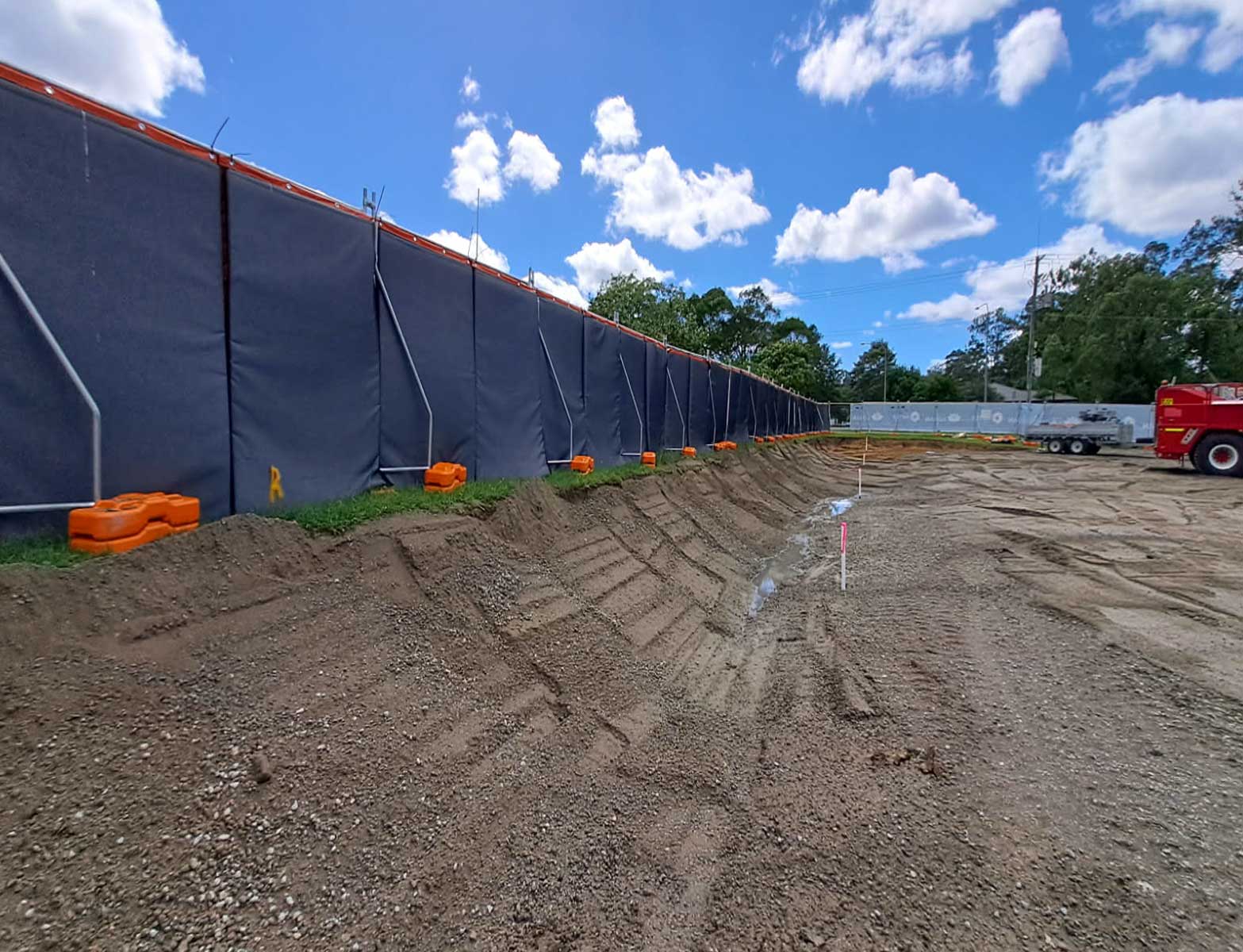
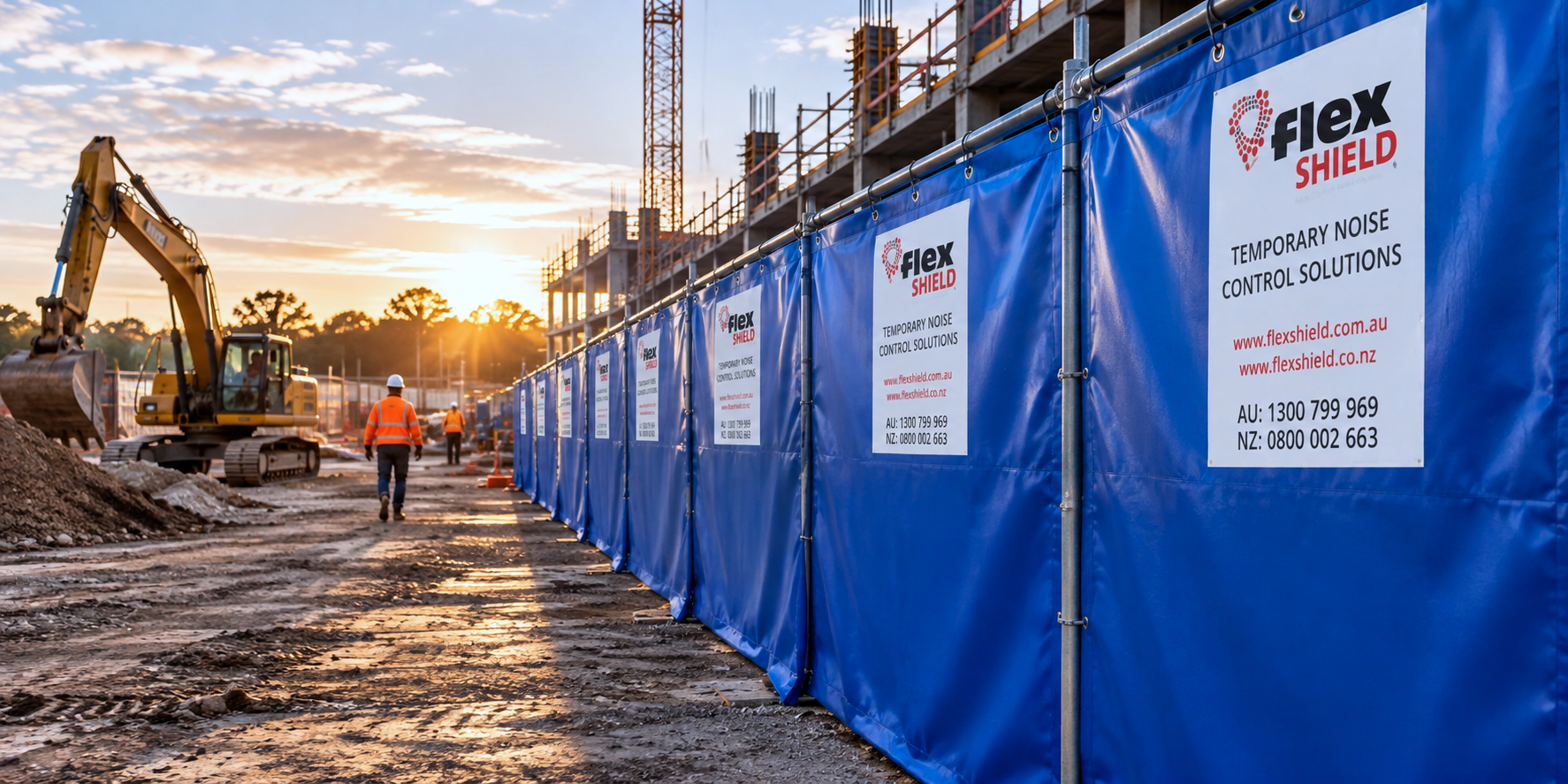
Where source controls cannot bring noise within limits, a physical barrier along the transmission path is the next step. This is where temporary and semi-permanent acoustic barriers, screens and curtains do the heaviest lifting on most Australian sites. A well-specified barrier can achieve a meaningful reduction in noise reaching a receiver, provided it has sufficient mass, height and continuous coverage with no significant gaps.
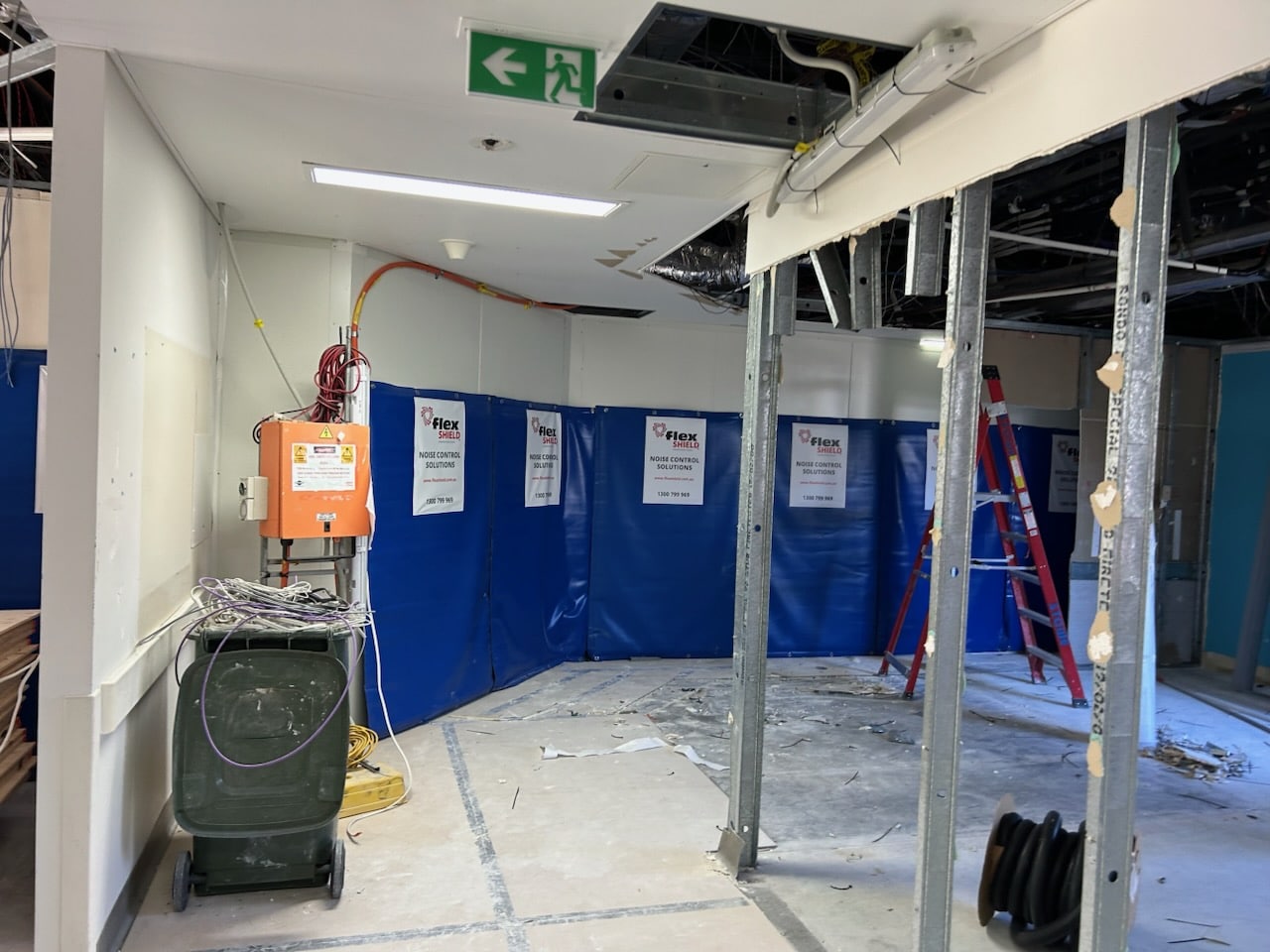
Receiver-based measures, such as temporary glazing upgrades or relocation of sensitive activities, are generally reserved for situations where source and path controls cannot achieve compliance, such as prolonged works next to a hospital or school.
Barrier performance depends on mass per square metre, height relative to the noise source and receiver, and how continuous the barrier is along its length. Gaps, overlaps, and unsealed edges are common reasons a barrier underperforms on site, regardless of the base material’s rated performance.
Short-duration activities, such as a piling programme measured in weeks, are usually best served by a relocatable noise barrier that can be moved with the plant. Longer programmes, particularly on sites adjacent to residential zones, often justify a semi-permanent perimeter barrier fixed to hoarding or scaffold for the duration of the works.
Flexshield’s Sonic acoustic curtains and Sonic acoustic quilt are engineered for both scenarios, with grommet and hook fixings that allow rapid relocation without compromising coverage.
Barrier materials on Australian sites need to handle UV exposure, wind loading, and repeated relocation without losing performance. Australian-manufactured barrier products are typically tested and specified against local conditions, rather than adapted from products designed for milder climates. That matters over a multi-month programme.
Before works commence, a baseline background noise measurement establishes the level against which construction noise will be assessed. Most guidelines set the acceptable construction noise level as a fixed increment above this background figure, so an accurate baseline is essential to setting realistic, defensible limits.
Standard construction hours in most states sit within 7am to 6pm on weekdays and 8am to 1pm on Saturdays, with variations by state and council. Any work proposed outside these hours generally requires a separate approval, supported by a specific noise management plan demonstrating why the work cannot occur within standard hours and how noise will be minimised.
Notifying neighbours ahead of noisy activities, providing a contact number for complaints, and following up promptly on any issues raised all reduce the likelihood of a complaint escalating to the EPA or council. This represents a modest administrative cost against the risk of a stop-work direction.
Ongoing monitoring, whether through attended spot checks or unattended noise loggers, can confirm that the barriers and controls specified in the NMP are performing as intended. Monitoring data also provides a defensible record if a complaint is received, showing what the actual noise levels were rather than relying on prediction alone. Site teams should review monitoring results against trigger levels regularly and adjust barrier placement, working hours or plant selection where a control is underperforming.
At Flexshield Group we manufacture our acoustic barriers, curtains and screening panels right here in Australia. They’re engineered for the demands of local construction sites and backed by NATA-accredited testing.
If you’re preparing a noise management plan or specifying barriers for an upcoming project, contact the Flexshield team for advice on the right barrier configuration for your site conditions.
We’ll make sure it’s built right from the start. Contact Flexshield on 1300 799 969 or get in touch online.
Proudly built by Flexshield Group
Designed to perform. Built to last.