
Call 1300 799 969 | Contact Us
Home » Future-ready welding workshop design for Australian TAFEs
A well-planned welding workshop has to do more than simply fit welding bays into a room. For Australian TAFEs and other trade training providers, the workshop needs to support students as they develop practical skills, give teachers clear visibility across the training area, and provide enough flexibility to accommodate changing course requirements, equipment, and class sizes.
Decisions made during the planning stage can influence how well the workshop operates for years. Getting the layout right early can also help avoid expensive alterations when training needs change.
At Flexshield Group, we have more than two decades of experience working with industrial and trade environments across Australia. We know that workshop planning works best when safety, access, supervision and future requirements are considered before equipment positions become fixed.
Before deciding where individual welding bays should go, it’s important to consider how students and teachers will move through the workshop during a normal training session. Ask yourself:
These practical questions help shape a layout that works in the real world rather than simply looking neat on a floor plan.
A welding workshop may need to accommodate individual welding tasks, teacher demonstrations, preparation areas, storage, assessment activities and movement between workstations. Mapping these activities before finalising the layout can identify potential congestion points and areas where additional separation may be required.
Supervision is an important part of trade training. Teachers need to be able to move between work areas and maintain visibility of students without constantly navigating around poorly positioned barriers, equipment or storage areas.
Welding bays should therefore be planned with supervision in mind. The layout needs to provide appropriate separation between individual work areas while still allowing instructors to oversee activities and reach students when assistance is required.
Visibility can be particularly important when students are learning new techniques and require regular guidance.
Rather than treating each welding bay as an isolated space, consider how the complete workshop functions as one training environment.
Movement around a welding workshop deserves careful attention. Students may be carrying tools, materials, PPE or completed work. Teachers need access to each training area, while maintenance staff may require enough room to inspect or service equipment.
A layout that creates narrow access points or unnecessary cross-traffic can make day-to-day operation harder than it needs to be.
Planning clear pathways around welding bays helps support safer movement and makes supervision easier. It can also make it simpler to reorganise individual areas when training requirements change.
Think about the workshop not just when it is empty, but when it’s at its busiest. That’s often where potential layout issues become obvious.
TAFE workshops rarely remain unchanged forever. New welding equipment may be introduced. Courses can change. Student numbers may increase. Teaching methods evolve, and spaces may need to accommodate different training activities.
A workshop designed only around today’s requirements can become restrictive surprisingly quickly. Where practical, incorporating modular elements into the workshop can give training providers greater freedom to adapt individual work areas without undertaking a major rebuild.
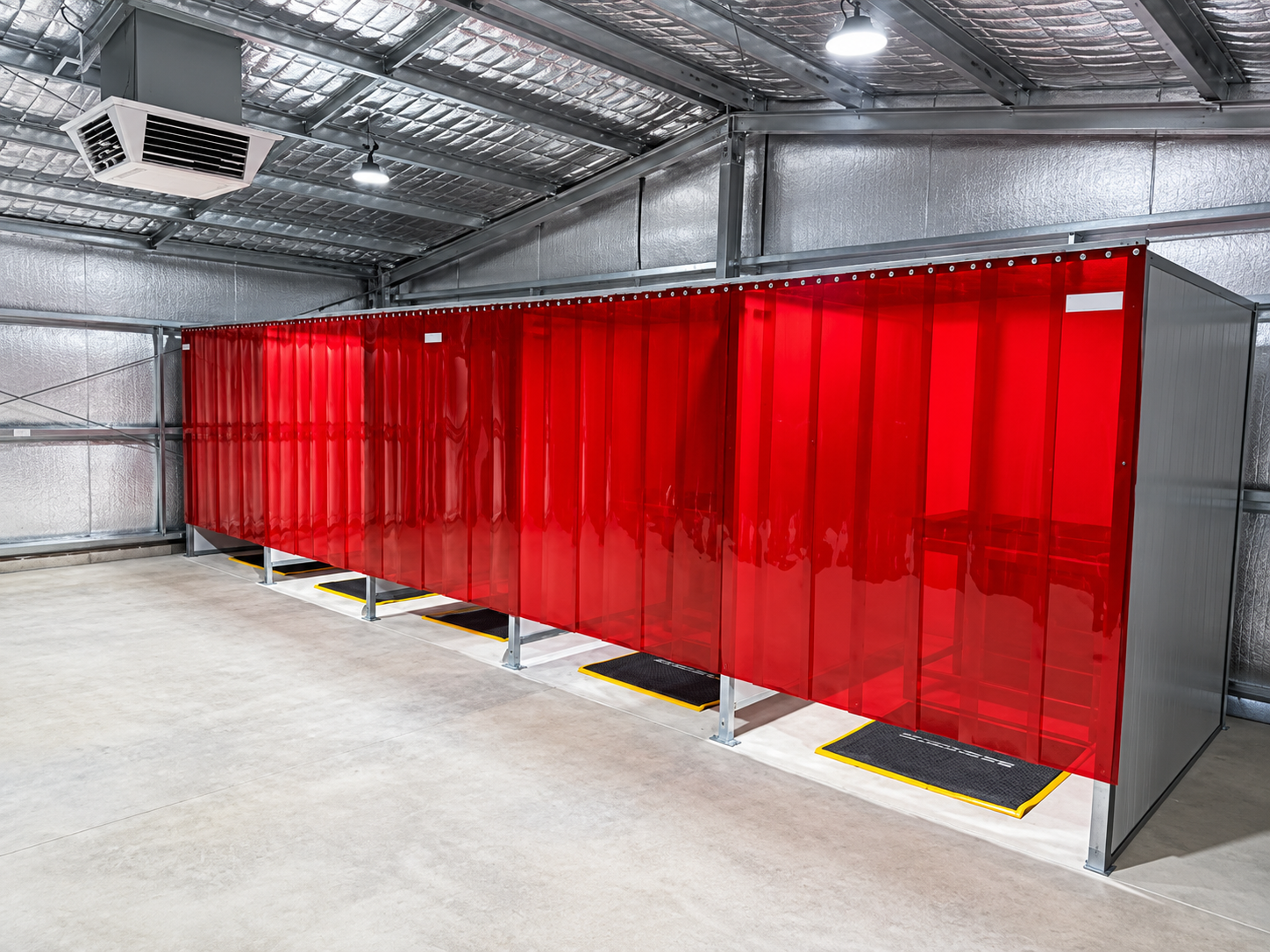
Flexshield Group manufactures welding screens and curtains in Australia for demanding workplace and training environments. Depending on the application, these products can help define individual work areas while allowing the overall workshop layout to be planned around practical training requirements.
The goal is not simply flexibility for its own sake. It’s about giving the facility room to change without unnecessarily starting again.
Planning for current enrolments makes sense, yet workshop designers should also consider what happens if demand for trade training grows. If additional welding bays may be required in future, identify where they could be positioned and how students would access them.
Consider whether the existing layout would still provide suitable circulation and supervision if more work areas were added. This does not necessarily mean building a larger workshop immediately. It means making informed decisions now that leave sensible options available later.
A little forward planning can be far easier than trying to squeeze another workstation into a layout that was never designed to accommodate it.
A TAFE welding workshop can see heavy daily use. Students are learning, equipment is moved, and work areas may be reconfigured regularly. Products used to separate welding activities therefore need to suit the demands of the environment.
Durability, appropriate screening, installation requirements and ongoing maintenance should all be considered during product selection.
Flexshield Group’s Australian-manufactured welding screens and curtains are designed for industrial and training applications. Selecting products that have been tested for their intended purpose gives designers, facilities teams and training providers greater confidence in the finished workshop.
Flexshield Group also has access to NATA-accredited testing as part of our commitment to verified product performance and dependable advice.
One of the easiest mistakes in workshop planning is leaving specialist requirements until the building layout is almost complete. By that stage, equipment positions, access routes and services may already be locked in.
Early input gives workshop planners more opportunity to consider bay dimensions, screening requirements, teacher visibility, access and future expansion as part of the overall welding workshop design. It can also help identify practical issues before they become expensive changes on site.
For architects, TAFE facilities teams, builders and education planners, involving experienced suppliers during the design stage can make the specification process more straightforward.
A new workshop will always look its best before the first class walks through the door. The better test is how it performs after months and years of regular use.
These questions help shift the planning conversation from simply fitting out a room to creating a workshop that can continue supporting trade training well into the future.
Future ready welding workshop design is not about trying to predict every change that might occur over the next decade. It’s about creating a practical foundation.
By considering layout, supervision, movement, durability and future growth right from the beginning, Australian TAFEs can create welding workshops that work for today’s students while retaining the flexibility needed for tomorrow’s training requirements.
Flexshield Group works with TAFEs, architects, builders, and facilities teams during the planning stage to help specify Australian-manufactured welding screens and curtains for trade training environments.
We’ll make sure it’s built right from the start. Contact Flexshield on 1300 799 969 or get in touch online.
Proudly built by Flexshield Group
Designed to perform. Built to last.