

Call 1300 799 969 | Contact Us
Home » PVC screens for food manufacturing production areas
Separating a raw ingredient area from packing, a washdown bay from a dry zone, or a chilled room from an adjoining production space can appear straightforward. That’s until people, trolleys, forklifts, cleaning routines and product movement are added to the picture.
In food manufacturing, a divider cannot be judged only by whether it creates a visible boundary. It also has to support the hygiene plan, allow the required traffic to move through the area, and stand up to the cleaning and operating conditions around it. The screen has to suit the way the production area actually works
That’s where PVC screening can be useful, provided the configuration is chosen for the job rather than treated as a one-size-fits-all curtain.
Before choosing PVC strips, sheets or doors, define the job of the boundary. One production area may need separation to limit splash or airborne contamination. Another may need to help retain chilled air. A third may simply need a clear physical division between processes while allowing frequent personnel or equipment movement.
These requirements affect the amount of coverage, the access method, the PVC configuration and the mounting hardware. A screen intended for a low-traffic clean zone opening should not automatically be specified in the same way as an opening crossed by pallet jacks or forklifts throughout a shift.
Flexible PVC strip curtains are well suited to doorways and production openings where people or equipment need to pass regularly. The overlapping strips form a physical barrier when the opening is not in use, then part as traffic moves through and fall back into position afterwards.
Flexshield Flexible PVC Strip Curtains are custom-made to each opening and are available in different strip widths and thicknesses. Clear PVC retains visibility between adjoining areas, which can help operators see approaching personnel or equipment before crossing the boundary.
Curtain overlap matters. More overlap increases coverage, but it also increases the resistance a person or trolley feels when moving through the curtain. In a food production area, the specification needs to balance containment with the frequency and type of traffic using the opening.
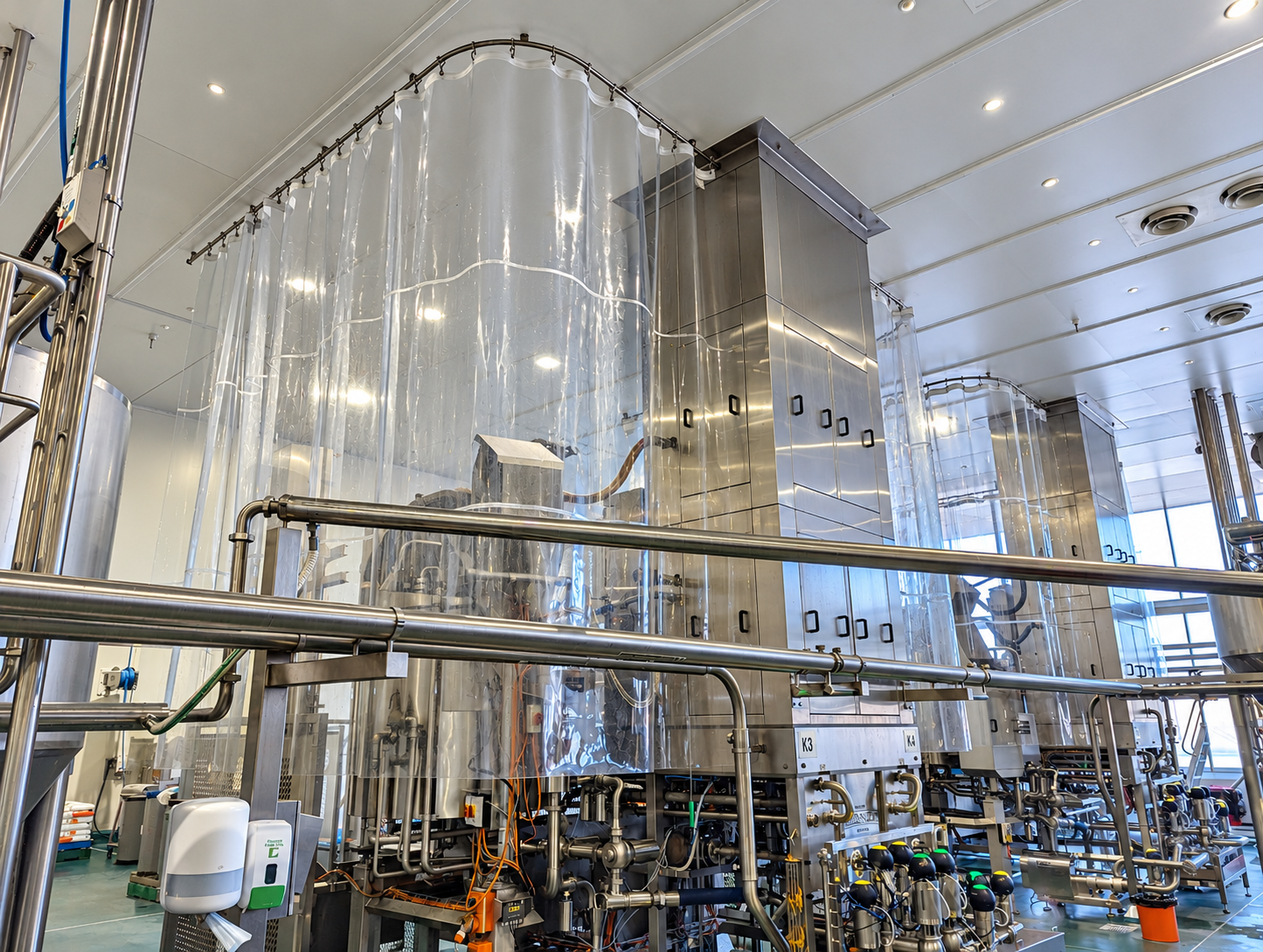
Some areas need a broader, more continuous barrier rather than a walk-through strip curtain. SonicClear PVC screens and barriers can use clear sheet material to divide work zones, contain splash, or create separation around a process while maintaining visibility.
A sheet curtain can be fixed where access is not required, or configured on a track where the opening needs to be cleared. This can suit washdown areas, process separation, and larger openings where a full-width panel is more practical than individual strips.
The decision comes back to workflow. If operators need to cross the boundary every few minutes, a fixed sheet will become an obstacle. If the boundary is opened only for cleaning, maintenance or occasional equipment movement, a sliding or retractable arrangement may make more sense.
Food production screening has to fit the facility’s cleaning program. Smooth PVC surfaces are straightforward to wipe or wash, while stainless steel mounting options can be selected where corrosion resistance and regular cleaning are priorities. Flexshield also offers hook-on track arrangements that allow strips to be removed when access for cleaning or replacement is required.
Curtain mounting detail deserves as much attention as the curtain material. Tracks, fixings, edges and adjoining surfaces should be considered in the context of the site’s hygiene procedures. The aim is to create a useful boundary without introducing hard-to-reach areas that complicate cleaning.
Flexshield products can be specified for use in HACCP-aligned production environments where the material and installation approach suit the application. This should not be confused with a blanket claim that every PVC product is HACCP certified. The facility’s own food safety plan and project requirements still govern the final specification.
Water spray and cleaning chemicals can travel well beyond the area being washed. A clear PVC barrier can help keep that activity within the intended zone, while allowing staff to see what is happening on the other side.
Flexshield’s manufacturing capability page shows a SonicClear wash bay curtain supplied for Beerenberg Family Farm for contamination control. It is a useful food manufacturing example because the screen addresses a practical production issue without permanently closing off the work area.
For wet areas, consider how the screen will drain, how close it should sit to the floor, whether the track and fixings need additional corrosion resistance and how the curtain will be moved or cleaned between production cycles.
Chilled processing and cold storage areas often need frequent access, which makes a conventional door inconvenient for some openings. PVC strip curtains can help reduce the exchange of air between zones while allowing regular movement through the opening.
This does not make a strip curtain a replacement for an insulated wall or a properly specified cold-room door where those are required. It is better viewed as a flexible boundary for openings where access frequency and temperature separation both matter.
Strip thickness, overlap, opening size and traffic all influence how the curtain behaves in use. Those factors should be considered together rather than selecting the heaviest PVC by default.
Clear PVC lets people see through the boundary before they cross it. In production areas shared by pedestrians, trolleys and mobile equipment, that visibility can be an important part of maintaining orderly traffic.
It also allows supervisors to see activity in an adjoining zone without opening the barrier. Where privacy, light control or a specialised hazard requires a different material, that requirement may change the choice of screen. For routine food production segregation, clear PVC is often useful because separation does not have to mean losing line of sight.
A curtain can only manage the pathway it covers. Gaps at the sides, excessive clearance at the floor, an opening that is frequently tied back, or a traffic pattern that leaves the curtain displaced can all reduce the value of the separation.
The surrounding airflow also matters. If extraction, supply air or large fans are moving contaminants from one zone to another, a PVC screen may form part of the control approach but should not be expected to correct the ventilation design on its own.
A Flexshield project for Nexdor Systems shows the same principle in a non-food manufacturing setting. Sliding SonicClear strip curtains were configured across two openings to reduce dust transfer between processing areas while still allowing the openings to be cleared for access. The application is different, but the design lesson carries across to food production. Containment and access have to be considered together.
A useful food manufacturing specification should record more than the opening dimensions. Note who and what passes through the area, how often the boundary is crossed, the washdown routine, chemicals used around the screen, temperature conditions and whether the area changes function between production runs.
Then consider the mounting arrangement and maintenance plan. Individual PVC strips can be replaced if damaged. Sliding sections can clear a larger opening when required. Stainless steel hardware can suit areas where regular washing or corrosive conditions are part of the operating environment.
This level of detail helps avoid two common problems. The first is a curtain that provides plenty of coverage but frustrates everyday movement. The second is a screen that is easy to pass through but leaves too much open area to provide the separation the process needs.
Choose the boundary that fits the food production process
Talk to Flexshield about PVC screens for Food Manufacturing
PVC screening can be a practical way to divide food manufacturing areas when the specification starts with hygiene, workflow and the reason for separation. Strip curtains, sheet curtains and tracked configurations each suit different traffic patterns and production needs.
Flexshield Group manufactures SonicClear PVC screening products in Australia and can configure screens around the opening, access requirements, cleaning conditions and production layout. Where verified acoustic performance is also part of the project, relevant Flexshield products have independent testing through NATA-accredited facilities. For food production screening, the starting point should remain the operational and hygiene requirements of the area.
We’ll make sure it’s built right from the start. Contact Flexshield on 1300 799 969 or get in touch online.
Proudly built by Flexshield Group
Designed to perform. Built to last.