

Call 1300 799 969 | Contact Us
Home » Noise transmission path control in manufacturing facilities
The loudest machine in a manufacturing facility is rarely the whole problem. Though a press, punch, compressor or cutting line may be the obvious place to start when a noise reading is too high, the engineering decision is not simply “cover the machine”. In a working factory, the result depends on where the noise is generated, how it travels through the building, and where people are exposed.
That distinction matters, because two factories with similar machinery can need very different controls. One machine may be suited to a close-fitting enclosure. Another may need open access for materials, forklifts or maintenance, making a barrier along the transmission path the more practical choice. In some facilities, the best result comes from treating both points.
Here’s what to look for when deciding on the right engineering controls for your facility.
A useful way to frame a manufacturing noise problem is to look at three points:
Australian workplace guidance follows the hierarchy of control. Elimination and quieter plant should be considered first. Where that is not reasonably practicable, isolation and engineering controls can include distance, barriers, enclosures and changes to plant or process. This is why the source and the transmission path both belong in the engineering discussion rather than being treated as competing ideas.
Controlling noise close to the machine is usually worth investigating first, because it limits the amount of noise entering the wider work area. Source treatment can range from changes to the machine itself through to enclosing the noisy process.
A well-designed acoustic enclosure can be a strong fit where one item of plant dominates the exposure and the process can be enclosed without compromising operation. Flexshield Acoustic Enclosures can be configured around machinery, access points, vision requirements and material infeed or outfeed. Sonic System acoustic modular panels can also be used to form rigid enclosures and partitions around industrial plant.
Source control is particularly useful when workers move around the factory rather than staying behind one fixed barrier. Reducing the noise leaving the machine can lower exposure across several nearby work areas at once.
Source treatment is not always practical. A long production line may have many noisy points. A machine may need frequent access from several sides. A process may release heat or require substantial airflow. In such cases, interrupting the transmission path can provide a more workable engineering approach.
A rigid wall or barrier can block the direct line between the noisy area and the people who need protection. Sonic System acoustic modular panels can be used for fixed industrial barriers, while Sonic acoustic curtains can suit areas where access or layout changes need more flexibility. Where air must pass through an opening, Sonic Series acoustic louvres can help reduce noise transmission while retaining ventilation.
The design still needs to follow the actual route the noise takes. A barrier placed too far from the source, left with large gaps or installed below the direct line between the machine and receiver may deliver less reduction than expected.
A barrier only works on the path it interrupts. Noise can travel over the top, around the sides, and through gaps. It can also reflect from a roof, hard wall or nearby structure and arrive at the receiver by another route.
That is why barrier height, length, position and edge conditions matter. The closer the barrier can sit to either the source or receiver, the easier it can be to break the direct path. The surrounding factory geometry also needs to be considered. In enclosed manufacturing spaces, reverberation can reduce the benefit of relying on distance alone.
Openings deserve the same attention. A high-performing wall with an untreated personnel door, conveyor aperture or ventilation opening can leave a weak point in the overall assembly.
A noise control design that prevents technicians from servicing a machine, blocks process airflow, or creates an awkward material route will quickly become an operational problem. That’s why engineering controls have to fit the work, not just the noise model.
For an enclosure, that may mean specifying acoustic doors, removable panels, vision panels and carefully treated penetrations. For a barrier, it may mean locating the wall so forklifts and pedestrians retain safe access. For ventilated equipment, it may mean combining panels with acoustic louvres or attenuators rather than sealing the plant into a hot box.
These details are often where a source-only or path-only concept changes into a combined design.
Manufacturing facilities rarely behave like a simple diagram. A machine may need local treatment to reduce the main emission, while a barrier protects an adjacent work zone from residual noise. An enclosure may need acoustic louvres at ventilation openings. A fixed panel wall may need an acoustic door so the controlled area remains usable.
The goal is not to choose one category and defend it. The goal is to identify which routes contribute most to exposure, then place each control where it can do useful work without creating a new problem for production, access or maintenance.
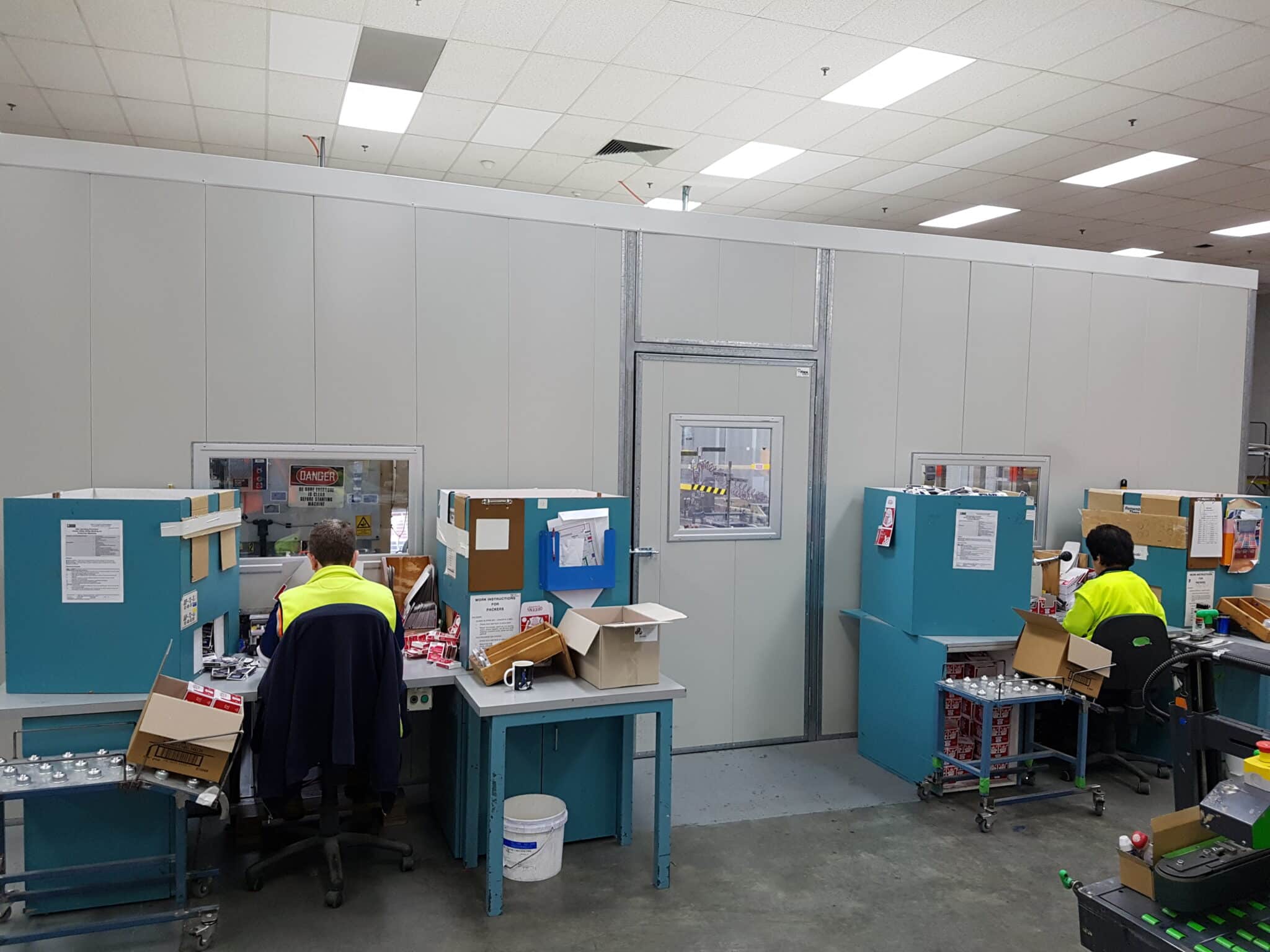
Flexshield Group used this approach when Australian Paper needed to reduce noise from a playing card punch machine in Victoria. The machine exceeded 85 dB and the project also required several access points, doors and conveyor openings.
After site measurements and assessment, Flexshield designed an enclosure using V50 Sonic System acoustic modular panels with vision panels and acoustic doors. The project is a useful example of source control shaped around the operating needs of the machine, rather than treating the enclosure as a sealed box.
Before choosing an enclosure, barrier or other product, work through the problem in sequence. Identify the dominant source, confirm where people are exposed, trace the main transmission routes and note every operational constraint that the control must accommodate.
Then ask which intervention removes the greatest amount of exposure with the fewest compromises. If one machine drives the problem, treatment at the source may be the stronger starting point. If several sources contribute to one receiver, or source access cannot be restricted, treatment along the transmission path may be more practical. Where several routes matter, a combined design may be required.
Noise measurements before and after installation also matter. Flexshield products are backed by independently verified data through NATA-accredited testing, giving engineers and facility teams a firmer basis for product selection and performance checks.
The right engineering decision comes from the way the factory operates. Machine layout, worker movement, access, maintenance, airflow and the building itself all influence whether noise should be treated at the source, along the transmission path, or at both points.
Flexshield Group designs and manufactures industrial noise control products in Australia, with Australian-manufactured panels, enclosures, barriers, doors, louvres and related products configured around real industrial requirements. A site assessment can help determine where the control should sit before drawings and fabrication begin.
We’ll make sure it’s built right from the start. Contact Flexshield on 1300 799 969 or get in touch online.
Proudly built by Flexshield Group
Designed to perform. Built to last.